

When you hand over your kitchen to a renovation crew, you are placing a significant amount of trust in a process you cannot fully observe or evaluate in real time. You see the before and you will eventually see the after, but everything that happens in between, the decisions made when walls are open, the tolerances held or missed during cabinet installation, the care taken with plumbing connections and electrical rough-in, all of that happens largely out of your sight. Quality control in kitchen renovation is the system of practices, checks, and standards that determines whether what happens in between matches what was promised.
Understanding how a professional kitchen renovation company approaches quality control throughout an installation gives homeowners a genuinely more complete picture of what separates excellent renovation outcomes from mediocre ones. It also gives you a framework for evaluating the professionalism of any renovation company you are considering working with.
What Quality Control Actually Means in Kitchen Renovation
Quality control is one of those phrases that gets used so frequently in marketing materials that it can start to feel meaningless. But in the context of kitchen renovation, it refers to something very specific and genuinely important. It is the collection of systematic practices through which a renovation company verifies that each stage of the installation meets established standards before moving forward to the next stage.
Think of quality control in kitchen renovation the way you might think about quality control in manufacturing. A product that goes through multiple quality checks at each stage of production is far less likely to have defects in the finished product than one that only gets inspected at the end. The same principle applies in renovation. Problems caught early, before subsequent work has been built on top of them, are dramatically easier and less expensive to correct than problems discovered at the final walkthrough.
Why Quality Control Is a Process Not a Single Inspection
One of the most important things to understand about genuine quality control in kitchen renovation is that it is not a single event. It is a continuous process woven through every phase of the installation from the initial site preparation through the final detail work. A renovation company that only checks quality at the end of the project is not practicing quality control. It is practicing damage assessment.
The reason sequential quality control matters so much in renovation specifically is that kitchen installations involve multiple layers of work where each layer depends on the one beneath it. Cabinet installation depends on the walls and floor being prepared correctly. Countertop fabrication depends on cabinet installation being accurate. Backsplash installation depends on countertops being set correctly. If a problem at any layer goes undetected, it creates compounding challenges for every layer that follows.
How Quality Standards Get Established Before Work Begins
Quality standards in a renovation project do not appear spontaneously. They get established through the planning and documentation process that precedes any physical work. A renovation company with genuine quality control practices uses the pre-project phase to define explicitly what acceptable installation looks like for every element of the project.
This definition process involves reviewing manufacturer installation requirements for every product being installed, establishing the tolerances that will be held for level, plumb, and square measurements throughout the project, identifying the inspection points where work will be checked before progressing, and documenting the standard that each element of the installation must meet before it is considered complete. This documentation serves as the benchmark against which actual installation quality gets measured throughout the project.
In addition to technical standards like level, plumb, and material specifications, professional renovation companies also establish early guidelines for maintaining visual and functional harmony across the entire kitchen. This is why experienced teams place strong emphasis on structured planning and coordination from the very beginning, which directly supports maintaining design consistency during a renovation throughout every stage of the project.
Humanize 115 words
Pre-Installation Quality Control Measures
The quality control process begins before any tools come out and any demolition starts. What happens in the pre-installation phase sets the conditions for everything that follows, and companies that invest serious attention in this phase tend to produce better installation outcomes than those that treat pre-installation planning as a formality.
How Material Verification Prevents Installation Problems
One of the most common sources of installation problems in kitchen renovation is material discrepancies that are not caught until they are already partially installed. Cabinets that arrive from the manufacturer with incorrect dimensions, countertop materials with visible defects, tiles with color variation that exceeds acceptable tolerances, flooring with mill run inconsistencies, all of these issues are far easier to address before installation begins than after.
A quality-focused kitchen renovation company inspects delivered materials before installation begins. This inspection includes verifying that the products delivered match the specifications on the order, checking for visible damage that may have occurred during shipping, confirming that cabinet dimensions match the measured kitchen space, and identifying any quality issues with surface materials that would be unacceptable in the finished installation.
This pre-installation material verification step seems straightforward, but it is more frequently skipped or done inadequately than homeowners would expect. The pressure to keep a project moving on schedule can create incentives to proceed with installation even when material concerns have been identified, with the intention of sorting out the issue later. Quality-focused companies resist this pressure because they understand that addressing a material problem before installation is vastly simpler than addressing it afterward.
Why Site Measurement Verification Is a Critical First Step
Kitchen cabinet systems are designed with precise dimensions, and the success of the installation depends on those dimensions matching the actual dimensions of the space they are being installed in. Measurement errors that go undetected until installation day can cause significant problems, ranging from minor adjustments to complete cabinet reordering in severe cases.
Professional renovation companies verify site measurements at multiple points before installation. The initial measurements taken during the design phase establish the parameters for the cabinet order. A second measurement verification is typically performed after demolition, when the actual wall surfaces, floor conditions, and structural elements are fully visible. This second measurement can reveal conditions that were not apparent before demolition, such as walls that are significantly out of plumb, floors with unexpected slopes, or structural elements that affect the planned cabinet configuration.
How Subcontractor Qualification Affects Overall Quality
Kitchen renovation typically involves multiple trades beyond the general renovation crew. Plumbers, electricians, tile setters, countertop fabricators, and flooring specialists may all contribute to a single kitchen project. The quality of the overall installation depends not just on the renovation company’s own standards but on the standards of every trade involved in the project.
A renovation company with genuine quality control practices maintains a qualified subcontractor network and takes responsibility for the quality of subcontractor work as part of the overall project quality. This means vetting subcontractors for their technical qualifications and track record, briefing them on project-specific standards and requirements, inspecting their work at completion before subsequent trades build on it, and holding them accountable for meeting the same quality standards as the renovation company’s own crew.
Quality Control During the Demolition Phase
Demolition is often viewed as a straightforward part of renovation, but the way it is executed has real implications for installation quality in the phases that follow.
How Demolition Is Managed to Protect Existing Structures
Careful demolition protects elements of the existing kitchen structure that will remain in place or that will be built upon. This includes the wall framing, which serves as the structural support for new cabinets and needs to be intact and sound. It includes the subfloor, which needs to be undamaged to support new flooring installation. It includes plumbing rough-in that will be reused and electrical rough-in that will be incorporated into the new design.
Demolition that proceeds too aggressively or without careful attention to what is being removed versus what is being preserved can damage these elements in ways that create significant complications for subsequent installation. A quality-focused renovation company approaches demolition with the same care as construction, using appropriate tools for each material being removed and stopping to assess conditions whenever something unexpected is encountered.
What Gets Inspected After Demolition Before New Work Begins
The post-demolition inspection is one of the most important quality control checkpoints in the entire renovation process because it is the moment when hidden conditions become visible. Walls opened during demolition may reveal insulation problems, moisture damage, pest damage, or structural issues that were not apparent before the project began. The subfloor exposed after old flooring removal may show rot, soft spots, uneven areas, or previous water damage that needs to be addressed before new flooring is installed.
A thorough post-demolition inspection documents what was found, what needs to be addressed before new work begins, and how those conditions will affect the installation plan. Identifying and addressing these issues at this stage, rather than proceeding with installation and hoping the problems will not matter, is a fundamental quality control practice that separates professional renovation from amateur work.
Cabinet Installation Quality Control
Cabinet installation is the structural backbone of the finished kitchen, and the quality of this installation affects not just the appearance of the finished kitchen but the long-term functionality and durability of the entire space.
How Level and Plumb Verification Affects Long Term Cabinet Performance
The terms level and plumb describe two related but distinct properties of cabinet installation. Level refers to whether horizontal surfaces are perfectly horizontal, oriented perpendicular to the direction of gravity. Plumb refers to whether vertical surfaces are perfectly vertical, parallel to the direction of gravity. Cabinets that are not installed level and plumb will cause problems that compound over time.
Upper cabinets installed out of plumb will not close correctly because the door hinges are designed for a plumb door frame. Base cabinets installed out of level will cause countertop surfaces to slope, creating visible gaps at walls and appliances and potentially affecting the function of sinks and dishwashers that depend on proper drainage. A run of base cabinets that starts slightly out of level at one end will accumulate that error across the entire run, potentially resulting in a significant height differential by the time the installation is complete.
Quality cabinet installation involves checking for level and plumb at the beginning of the installation, at regular intervals throughout, and at completion of each cabinet run. The standard tolerance for level and plumb in professional cabinet installation is typically one-eighth of an inch over ten feet, which is tight enough to ensure proper door and drawer function without being so strict as to be impractical in the real-world conditions of residential kitchen spaces.
Why Screw Placement and Fastening Patterns Matter
The structural integrity of a cabinet installation depends on more than just the cabinets themselves. It depends on how they are fastened to the wall structure and to each other. Wall cabinets in particular are supporting their own weight plus the weight of everything stored in them, and they are typically mounted to wall studs that need to be located accurately for the fasteners to provide adequate holding strength.
Quality cabinet installation follows established fastening patterns that ensure cabinets are secured to studs rather than just to drywall, that cabinets are fastened to each other across their face frames to create a unified and rigid run, and that the fastener size and type is appropriate for the load the installation needs to support. A kitchen renovation company with genuine quality control practices inspects fastening as the installation proceeds rather than assuming it has been done correctly.
How Face Frame Alignment Gets Checked During Installation
Face frame alignment refers to the precise positioning of adjacent cabinet units so that their face frames, the front structural frames of the cabinet boxes, are flush with each other and aligned both horizontally and vertically. When face frames are misaligned, the gaps between cabinet doors are uneven, the doors themselves may not hang straight, and the overall visual appearance of the finished cabinet run has an unprofessional quality that is immediately noticeable even to an untrained eye.
Checking face frame alignment involves using a straightedge across the faces of adjacent cabinets to verify that they are coplanar, measuring the reveal, which is the visible gap between the cabinet face frame and the door edge, to confirm it is consistent across all doors in the run, and verifying that the alignment is correct before driving the face-to-face fasteners that lock the cabinets in their final relative position.
Countertop Installation Quality Control
Countertop installation quality control begins before the countertop material ever arrives at the job site, with the template process that translates the actual conditions of the installed cabinets into the precise dimensions used to fabricate the countertop.
How Template Accuracy Determines Countertop Fit
Countertop fabrication for natural and engineered stone materials begins with a template process where the fabricator creates an exact pattern of the countertop layout directly from the installed cabinets. This template captures the actual dimensions, angles, and contours of the cabinet installation rather than relying on design drawings, because even a very accurate cabinet installation will have minor variations from the planned dimensions.
The quality of the template process directly determines how well the fabricated countertop fits the installed cabinets. A precisely made template produces a countertop that fits the space cleanly, with consistent overhang at the front and sides, tight joints at walls and backsplash surfaces, and correct cutout sizing and placement for sinks and cooktops. Template errors produce countertops that do not fit correctly and may require field modifications, shimming, or in the worst cases, complete refabrication.
Why Seam Placement and Finish Are Quality Indicators
In kitchens where countertop runs are too long to be fabricated in a single piece, or where corners require separate pieces to be joined, seams are an unavoidable element of the installation. The placement and finish quality of these seams are among the most visible indicators of overall countertop installation quality.
Seam placement is an aesthetic and structural decision. Seams are best placed away from sink cutouts and other stress points that could cause them to fail under load. They are best located where they will be least visually prominent in the finished kitchen. And they need to be cut and joined with the precision required to achieve a tight fit with minimal visible gap.
Seam finish quality in stone countertops involves color matching the epoxy used to fill the seam to the surrounding material, achieving a surface level across the seam that is perfectly flush, and finishing the seam to the same surface texture as the surrounding countertop. A seam done poorly stands out visually and can become a functional problem as the epoxy degrades over time.
Plumbing and Electrical Quality Control During Kitchen Renovation
Plumbing and electrical work in kitchen renovation involves licensed trade professionals in most jurisdictions, and quality control for these elements involves both inspection by the renovation company and formal inspection by municipal building officials where permit requirements apply.
How Rough-In Inspections Protect Final Installation Quality
Rough-in refers to the plumbing and electrical work that is done before walls and cabinets cover it up, including supply and drain line positioning for sinks, the stub-out location for dishwasher connections, electrical circuit rough-in for new outlets and fixtures, and gas line rough-in for gas appliances. Getting these rough-in elements right before they are covered is critical because accessing them after the kitchen is installed requires opening finished surfaces.
A quality-focused kitchen renovation company verifies rough-in positioning before work proceeds past the point where corrections are straightforward. This means confirming that drain rough-in heights match the planned cabinet and sink configuration, that supply line rough-in locations will not conflict with cabinet components, and that electrical rough-in positions for outlets and switches match the planned locations in the design.
Why Fixture and Appliance Connection Verification Matters
After rough-in, the quality control focus shifts to the connections between the rough-in infrastructure and the fixtures and appliances being installed. Faucet connections need to be checked for leaks under pressure. Dishwasher water supply and drain connections need to be verified as secure and properly routed. Garbage disposal installations need to be tested for proper mounting and electrical connection. Appliance gas connections need to be pressure tested and verified as leak-free.
These verifications are not optional steps to be skipped when schedule pressure mounts. They are the difference between a kitchen that functions correctly from day one and one that develops problems ranging from minor annoyances to serious water damage in the weeks and months after installation.
Flooring Installation Quality Control
Kitchen flooring installation quality control addresses both the preparation of the substrate beneath the flooring and the installation of the flooring material itself.
How Subfloor Assessment Affects Finished Floor Quality
The condition of the subfloor has a direct and significant effect on how the finished floor looks and performs. Soft spots in the subfloor will cause tile floors to crack as the tile flexes over the unsupported area. Humps and dips in the subfloor will be visible in rigid flooring materials that follow the contours of the subfloor rather than bridging them. Subfloor squeaks that are not addressed before new flooring is installed become permanent features of the finished floor.
Subfloor assessment before flooring installation involves checking for soft areas that indicate rot or structural damage, testing for squeaks and addressing their source rather than covering them, measuring the flatness of the subfloor surface and addressing any humps or dips that exceed the tolerance specified by the flooring manufacturer, and verifying that the subfloor is at the appropriate height to transition correctly to adjacent floor surfaces.
Why Expansion Gap Verification Matters in Flooring Installation
Most flooring materials expand and contract with changes in temperature and humidity. Wood flooring expands significantly as humidity rises and contracts as it falls. Luxury vinyl plank has thermal expansion characteristics that require accommodation in the installation. Even tile grout joints serve in part to provide accommodation for slight dimensional changes in the tile substrate system.
Expansion gaps are the deliberate spaces left at the perimeter of a flooring installation, at transitions to other flooring materials, and around fixed objects like cabinet toe kicks and island bases, that allow the flooring material to move without buckling or cracking. A flooring installation without proper expansion gaps will develop problems as the material expands and has nowhere to go. Verifying that expansion gaps are correctly sized and consistently maintained around the perimeter of the installation is a specific quality control check that gets done at completion of the flooring installation before cabinets and trim cover the gap.
How Final Walkthrough Inspections Work in Kitchen Renovation
The final walkthrough inspection is the formal quality control event that closes out a kitchen renovation project. It is the moment when the renovation company and the homeowner review the completed installation together, documenting any items that need correction before the project is considered complete.
What a Punch List Is and How It Ensures Completion Quality
A punch list is the written record of items identified during the final walkthrough that require attention before the project is fully complete. The term comes from the old practice of punching a hole next to each item on a checklist when it was completed. In contemporary renovation practice, it is a documented list of specific issues, each described clearly enough that the responsible party knows exactly what needs to be done to resolve it.
The punch list is a quality control tool because it creates a formal record of outstanding items and establishes an explicit standard for project completion. A project without a punch list process tends to end with a vague handshake and a few verbal notes about things to fix, some of which get addressed and some of which get forgotten. A project with a formal punch list ends with every identified issue documented, assigned to a responsible party, and tracked to completion.
How Homeowner Sign-Off Processes Work
The homeowner sign-off process is the formal mechanism through which the homeowner acknowledges that the project has been completed to the agreed standard. A properly structured sign-off process involves the homeowner reviewing every element of the installation systematically, having an opportunity to test all functional elements including faucets, appliances, cabinet hardware, drawers, and doors, and documenting any concerns before signing.
This sign-off process protects both the homeowner and the renovation company. It gives the homeowner a structured opportunity to identify any issues before the project is formally closed. It gives the renovation company clear documentation that the homeowner reviewed and accepted the installation at a specific point in time.
Regional Quality Standards in Kitchen Renovation Company Cleveland Context
In the context of the Kitchen Renovation Company Cleveland market, quality control practices are shaped by both the general standards of professional renovation and the specific conditions of the regional housing market. The prevalence of older homes in the Cleveland area means that renovation projects frequently encounter conditions that were not visible before demolition began, making the post-demolition inspection quality control checkpoint particularly important.
Companies operating in this market, like Cleveland Cabinets and others with deep experience in the regional housing stock, develop quality control practices informed by repeated experience with the specific challenges of older homes in Northeast Ohio. This regional knowledge, accumulated across many projects and many different house types and eras of construction, informs more effective quality control practice than generic renovation standards alone can provide.
Quality control in kitchen renovation is not a single act but a continuous commitment that runs from the first measurement taken in the planning phase through the final punch list item completed after installation. Every stage of the installation process has specific quality checkpoints where the work done so far gets verified against established standards before the project moves forward. The disciplines of pre-installation material verification, post-demolition inspection, sequential checks during cabinet and countertop installation, rough-in verification for plumbing and electrical, subfloor assessment before flooring, and formal final walkthrough inspection together constitute the quality control system that determines whether a kitchen renovation delivers the outcome the homeowner was promised. Understanding this system gives homeowners both a deeper appreciation of what professional renovation involves and a more informed basis for evaluating the quality practices of any renovation company they consider working with.
FAQs
1. How can a homeowner verify that a renovation company has genuine quality control practices?
Ask specific questions about their inspection process at each phase of the project, whether they use written checklists or documentation systems, how they handle subcontractor quality, and what their punch list and sign-off process looks like. Companies with genuine quality control practices can answer these questions specifically and confidently.
2. What should a homeowner do if they notice a quality problem during installation?
Raise it immediately rather than waiting until the project is complete. Problems addressed during installation are far easier to correct than those addressed after subsequent work has been completed on top of them. A professional renovation company will have a clear process for receiving and addressing quality concerns during the project.
3. Does permit inspection replace the renovation company’s own quality control?
No. Municipal permit inspections verify code compliance at specific stages of a project, but they are not comprehensive quality inspections. They do not check aesthetic quality, manufacturer installation requirements, or the many dimensions of installation quality that do not fall under building code jurisdiction. The renovation company’s own quality control practices need to be independent of and more comprehensive than permit inspection requirements.
4. How does quality control affect the timeline of a kitchen renovation project?
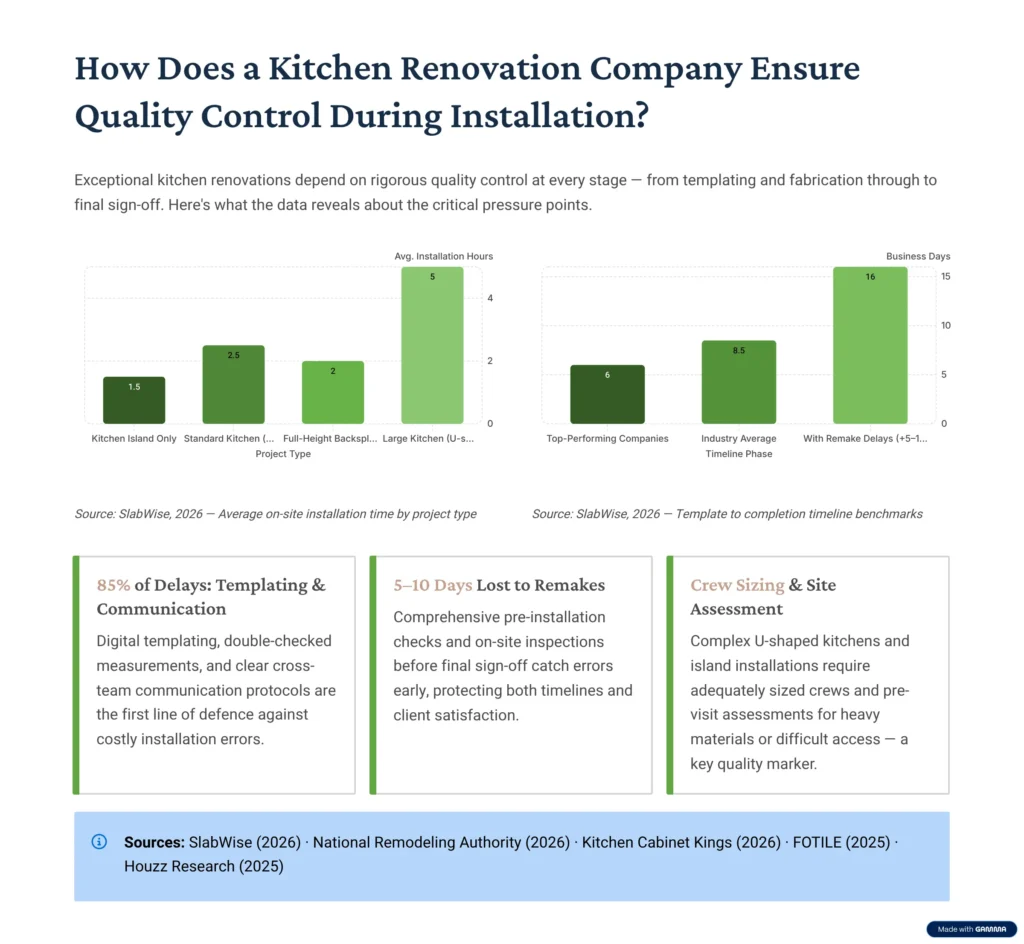
Quality control adds time to individual stages of a project because checking work takes time and correcting problems takes more time. However, quality control ultimately reduces total project time by catching problems early when they are quick to fix, preventing the compounding delays that occur when installation problems discovered late in a project require reopening completed work.
5. What is the most commonly missed quality control checkpoint in kitchen renovation?
The post-demolition inspection is among the most frequently skipped or inadequately performed quality control checkpoints in residential kitchen renovation. The pressure to maintain schedule momentum after demolition is complete creates incentives to begin new work quickly, but the conditions revealed by demolition often require assessment and sometimes remediation before installation can proceed correctly.