
Think about everything that happens in a kitchen on a single ordinary day. A cutting board gets dragged across the counter. Chair legs scrape the floor as someone sits down for breakfast. A pan gets set down with slightly more force than intended. Keys get tossed onto the countertop. Children run through with shoes that have been places shoes should not have been. A grocery bag with a rough bottom gets slid across the surface near the sink. None of these moments feel significant on their own. But accumulated over weeks, months, and years, they leave a record on every surface in the kitchen.
Scratches and marks in a kitchen are not just a cosmetic issue. They affect how surfaces clean, how long materials last, and in some cases how safe the kitchen is from a hygiene standpoint. Understanding how kitchen remodeling addresses this problem from a materials and construction perspective gives homeowners a much more informed basis for making renovation decisions.
Why Everyday Scratches and Marks Are a Bigger Problem Than They Seem
Most people think of scratches in the kitchen as purely aesthetic concerns. A mark here, a scuff there. Nothing serious. But the reality is more complicated than that, and understanding the full picture changes how you think about surface selection during a remodel.
How Surface Damage Accumulates Over Time
Surface damage in a kitchen follows a compounding pattern. The first scratch on a countertop is barely noticeable. The second one is slightly more visible. By the time you have fifty scratches in the same general area, the surface has developed a texture that traps food particles, harbors bacteria, and reflects light differently than the surrounding undamaged area. That visual dullness you notice on an aging countertop is not just wear in a general sense.
The same pattern applies to cabinet fronts, flooring, and backsplash surfaces. Every surface in a kitchen is subject to some form of daily mechanical contact, and the materials chosen during a remodel determine how well those surfaces hold up against that contact over the long term.
The Connection Between Surface Condition and Kitchen Hygiene
Here is something that often gets overlooked in conversations about kitchen surface maintenance. Scratched surfaces are harder to keep clean. This is not a matter of aesthetics. It is a matter of basic surface physics. A smooth unscratched surface has nothing for food particles, oils, and bacteria to adhere to beyond the surface tension of the material itself.
A scratched surface has microscopic channels and crevices that trap contaminants and shield them from cleaning products and surface wiping.
This is particularly relevant in areas around food preparation zones. A heavily scratched cutting counter that looks merely old and worn is actually a more significant hygiene challenge than its visual condition suggests. Kitchen remodeling that selects surfaces with genuine scratch resistance addresses this hygiene dimension alongside the aesthetic one.
How Kitchen Remodeling Addresses Surface Vulnerability at the Source
The most powerful thing a kitchen remodel does in terms of scratch and mark protection is replace surfaces that have already accumulated damage with new surfaces selected specifically for their durability characteristics. But beyond simply starting fresh, a thoughtful remodel makes deliberate choices about which materials go where, based on an honest assessment of what each surface will be subjected to on a daily basis.
A countertop near the sink gets wet frequently and also gets used as a landing zone for dishes, cookware, and groceries. A cabinet near the stove is exposed to heat and steam in addition to the normal mechanical contact from opening and closing.
A floor near the entrance to the kitchen sees foot traffic with outdoor footwear. Each of these zones has different scratch and mark resistance requirements, and a well-planned remodel addresses each of them with the appropriate material rather than applying a single approach across the entire kitchen.
Choosing Materials That Resist Scratching by Design
Not all kitchen surfaces are created equal when it comes to scratch resistance. The material itself, the way it is manufactured, the finish applied to it, and the way it is installed all influence how well it holds up against daily mechanical contact. Understanding the scratch resistance characteristics of the most common kitchen materials gives homeowners a genuinely useful framework for making remodeling decisions.
How Quartz Countertops Handle Daily Scratch Exposure
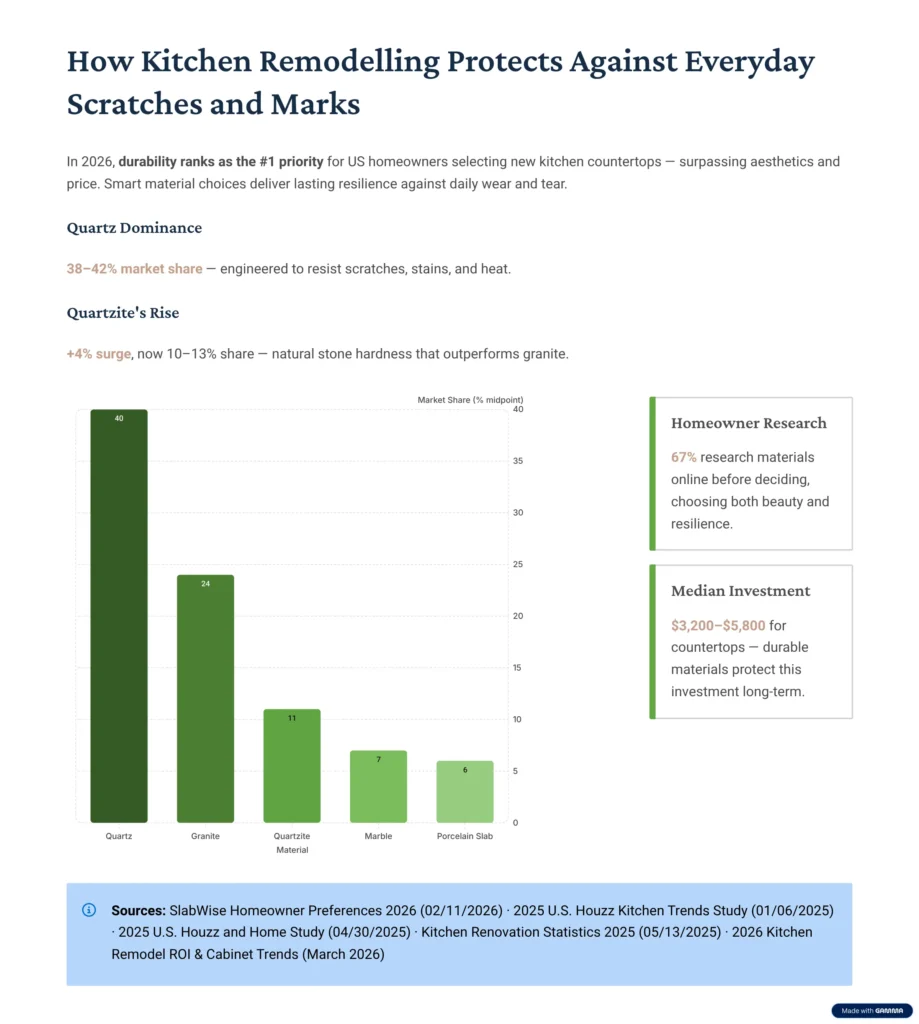
Quartz countertops are among the most scratch-resistant options available for kitchen surfaces, and understanding why helps explain what makes them particularly well suited to high-use kitchens. Engineered quartz is composed of approximately 90 to 95 percent ground quartz crystals bound together with polymer resins.
Quartz itself is one of the hardest naturally occurring minerals, rating a 7 on the Mohs hardness scale. For context, most steel kitchen knives rate between 5.5 and 6.5 on the same scale, which means a steel blade dragged across a quartz surface is actually softer than the surface it is contacting.
This hardness advantage means that under normal kitchen use conditions, quartz countertops resist scratching remarkably well. The polymer resin binder that holds the quartz particles together is softer than the quartz itself, which means the surface can show fine surface marks under very aggressive use, but the practical scratch resistance of a well-manufactured quartz countertop in a typical kitchen environment is genuinely excellent.
The non-porous nature of engineered quartz also contributes to its scratch resistance advantage from a hygiene perspective. Because the surface has no natural pores or veining channels like natural stone, any scratches that do occur are not connected to a network of subsurface pathways that could harbor bacteria.
Why Porcelain and Ceramic Tile Surfaces Resist Surface Marks
Porcelain and ceramic tile surfaces have been used in kitchens for centuries, and a significant part of their enduring popularity comes from their inherent scratch resistance. Porcelain tile in particular is fired at extremely high temperatures, which creates a surface that is dense, hard, and highly resistant to surface marking.
The grout lines between tiles represent a different kind of challenge. Grout, particularly traditional cement-based grout, is significantly softer and more porous than the tile itself. In high-traffic kitchen floor applications, grout lines can scratch, stain, and accumulate wear more visibly than the surrounding tile. Using epoxy grout rather than cement-based grout during a remodel addresses this vulnerability directly, since epoxy grout is both harder and less porous than its traditional alternative.
How Hardwood and Engineered Wood Flooring Handles Scratch Resistance
Wood flooring in a kitchen is a subject that tends to generate strong opinions because wood is inherently softer than many other kitchen flooring materials and therefore more vulnerable to scratching in some respects. But the picture is more nuanced than a simple hard versus soft comparison suggests.
The finish applied to a wood floor has as much influence on its scratch resistance as the wood species itself. A hard maple floor with a soft oil finish will scratch more easily than the same maple floor finished with a high-quality polyurethane coating.
Engineered wood flooring, which uses a real wood veneer bonded to a core of high-density fiberboard or plywood, often accepts the same surface finish systems as solid wood and can achieve similar scratch resistance performance while offering better dimensional stability in the moisture-variable environment of a kitchen.
Cabinet Finishes That Stand Up to Daily Contact
Cabinets are the surfaces in a kitchen that get the most direct hand contact on a daily basis. Every time a cabinet door or drawer is opened and closed, the finish is subjected to the mechanical friction of being grabbed, pushed, and pulled. Over time, this contact leaves marks around hardware, on door edges, and anywhere hands regularly make contact with the surface.
How Thermofoil and Laminate Cabinet Surfaces Resist Marking
Thermofoil cabinet doors, which are made by vacuum-bonding a vinyl film over an MDF core, offer a relatively scratch-resistant surface that also cleans easily. The vinyl surface layer is harder than a painted finish and does not show fingerprint oil as prominently as some other finishes.
Laminate cabinet surfaces share many of the durability advantages of thermofoil and have historically been used extensively in kitchen applications precisely because of their resistance to everyday wear. Modern high-pressure laminate in particular offers excellent scratch resistance that holds up well in high-traffic kitchens.
Why Painted Cabinet Finishes Vary in Scratch Resistance
Painted cabinet finishes are among the most popular choices in contemporary kitchen design, and their scratch resistance varies considerably depending on the type of paint used, the number of coats applied, and whether a topcoat protective layer is added over the paint.
Alkyd or oil-based paints typically cure to a harder finish than water-based latex paints, which gives them better scratch resistance in direct use comparisons. However, modern waterborne alkyd paints have significantly improved in hardness and durability and can now match or approach the performance of traditional oil-based finishes while offering easier application and cleanup.
The most durable painted cabinet finish systems use a catalyzed conversion varnish or polyurethane topcoat applied over the paint layer. This topcoat is significantly harder than the paint beneath it and provides the primary scratch resistance protection for the finish. Without this protective layer, even high-quality paint is vulnerable to surface marking from normal cabinet use.
How Wood Veneer Cabinets Handle Surface Wear
Wood veneer cabinet doors combine the aesthetic warmth of real wood grain with a construction that can accept a wide range of protective finish systems. The scratch resistance of a wood veneer cabinet door depends almost entirely on the finish applied over the veneer rather than the veneer itself. A thin veneer with a catalyzed lacquer topcoat will resist everyday marking far better than a thicker veneer finished only with a penetrating oil treatment.
The Role of Hardware and Edge Profiles in Preventing Surface Damage
Two aspects of kitchen remodeling that rarely come up in conversations about scratch resistance but have genuine practical significance are hardware selection and edge profile design.
How Soft Close Mechanisms Reduce Impact Damage Over Time
Soft close hinges and drawer slides are primarily marketed as comfort and convenience features, and that is a fair description of their most immediately noticeable benefit. But they also have a meaningful long-term impact on surface condition. Every time a cabinet door slams shut without a soft close mechanism, the impact transmits force through the door panel, the frame, and the surrounding wall cabinet structure.
Soft close mechanisms eliminate this impact load almost entirely. The door reaches the closed position at a controlled speed and settles into the frame with minimal force. The cumulative reduction in impact stress over the life of the kitchen is significant in terms of how well the finish condition holds up.
Why Edge Profiles on Countertops Affect Chip and Mark Resistance
The edge profile of a countertop is another detail that influences how well the surface holds up against everyday contact. A sharp 90-degree eased edge, while visually clean and modern, presents the thinnest possible cross-section of material at the point most likely to be contacted by passing objects, chair backs, hip checks, and anything else that bumps against the counter edge.
Rounded edge profiles like a bullnose or an ogee distribute the impact force of incidental contact across a larger surface area. This means that the same force that might chip a sharp edge is more likely to simply slide across a rounded one without causing damage. In high-traffic kitchens where the counter edge sees regular contact, this distinction can make a meaningful difference in how the countertop looks after five years of use.
How Backsplash Selection Influences Scratch and Mark Resistance
The backsplash is a kitchen surface that gets less discussion in scratch resistance contexts than countertops and floors, but it has its own specific exposure pattern. The area immediately behind the cooktop and near the sink is subject to splattering, heat, steam, and occasional direct contact with cookware, utensils, and cleaning tools.
Glass Tile Backsplashes and Surface Durability
Glass tile backsplashes have excellent inherent scratch resistance because glass rates high on the Mohs hardness scale and its smooth non-porous surface does not provide the adhesion points that softer materials do. The main vulnerability of a glass tile backsplash from a marking perspective is not the tile surface itself but the grout lines and the silicone caulk used at the transition between the backsplash and the countertop. Keeping these areas well maintained is what determines the long-term appearance of a glass tile installation.
Natural Stone Backsplashes and Their Maintenance Requirements
Natural stone backsplashes, including marble, travertine, and slate, bring beautiful texture and visual warmth to a kitchen but require a more active maintenance approach to resist marking. Marble in particular, while visually spectacular, is a relatively soft stone that scratches more easily than harder alternatives.
The surface sealing of natural stone backsplashes during and after installation is what primarily determines their resistance to both staining and surface marking over time.
How Flooring Choice During Kitchen Remodeling Affects Scratch Resistance
Kitchen floors have perhaps the most demanding scratch resistance requirements of any surface in the room. They are subject to foot traffic with outdoor footwear, dragged chair and stool legs, dropped objects, pet claws, and the constant low-level abrasion of grit and sand that gets tracked in from outside.
Luxury Vinyl Plank and Its Scratch Resistant Properties
Luxury vinyl plank flooring has become one of the most popular choices in kitchen remodeling partly because of its genuinely impressive scratch resistance characteristics. The wear layer that sits on top of the printed design layer in a luxury vinyl plank product is made from a clear polyurethane or aluminum oxide-reinforced coating that is specifically engineered for abrasion resistance.
Higher-end luxury vinyl products with thicker wear layers offer scratch resistance performance that approaches or matches the best hardwood floor finishes available. The practical advantage of luxury vinyl in a kitchen context is that its scratch resistance does not depend on periodic refinishing the way hardwood does. A scratched hardwood floor can be sanded and refinished to restore its appearance.
A scratched luxury vinyl floor cannot be refinished in the same way, but its initial scratch resistance is high enough that refinishing is rarely necessary within the normal life expectancy of the product.
Polished Concrete Floors and Surface Mark Resistance
Polished concrete floors have a scratch resistance profile that depends heavily on how they have been treated. A concrete floor that has been mechanically polished to a high sheen and then sealed with a penetrating lithium silicate densifier develops a surface that is genuinely very hard and resistant to most forms of everyday marking.
The densifier reacts chemically with the concrete to fill the pores in the surface and increase its hardness. The result is a surface that resists scratching from most kitchen activities while also being relatively easy to clean.
How Proper Surface Preparation During Remodeling Improves Long Term Durability
The scratch resistance of any kitchen surface is not determined solely by the material itself. The way that material is prepared and installed during the remodel has a significant influence on how well it performs over time.
Strong installation quality control helps ensure that protective coatings cure properly, edges are sealed correctly, and surfaces perform exactly as intended under daily kitchen use. For a deeper understanding of how professionals manage this process, you can explore how teams maintain installation standards through proper installation quality checks during a kitchen renovation process.
Why Primer and Sealer Application Affects Scratch Resistance
When cabinets are being painted or refinished during a remodel, the primer application step is not merely about adhesion. A properly applied primer creates a consistent base that allows the topcoat to cure to its designed hardness profile.
Paint applied over a poorly primed or unprimed surface may not achieve full hardness because the substrate absorbs solvent from the paint at an uneven rate, disrupting the curing process. The result is a softer finish that scratches more easily than the same paint applied over a properly prepared surface.
How Subfloor Preparation Protects Finished Floor Surfaces
Subfloor preparation is another installation factor that affects the long-term scratch resistance of finished flooring. A subfloor with humps, dips, or soft spots creates flexion points in the finished floor above it. When a rigid flooring material like porcelain tile or laminate is installed over a subfloor with flex in it, the finished floor surface flexes slightly under load.
That flexion can cause grout cracks in tile installations and can accelerate surface wear in laminate products. A properly leveled and stabilized subfloor eliminates this source of accelerated surface deterioration.
How Finishing Coats and Protective Treatments Work After Remodeling
The protective treatments applied to surfaces after installation represent the final layer of the scratch resistance system that a remodel creates.
The Role of Polyurethane and Hardwax Oil in Wood Surface Protection
Wood surfaces in a kitchen, whether flooring, open shelving, or butcher block countertops, benefit from protective finish systems that both penetrate the wood fiber and create a surface film. Polyurethane finishes create a hard protective film on top of the wood surface that acts as a sacrificial layer absorbing surface scratches without exposing the wood beneath.
Hardwax oil treatments penetrate the wood fiber and harden within it, creating scratch resistance from the inside rather than from a surface film. Each approach has its advantages, and the choice between them affects both the initial scratch resistance and the long-term maintenance requirements of the wood surface.
How Countertop Sealants Protect Against Everyday Marking
Natural stone countertops, and to a lesser extent some engineered stone products, benefit from periodic sealing with a penetrating impregnator sealer. This sealer does not sit on top of the stone surface but penetrates into it and occupies the microscopic pores within the material. The primary function of this sealing is stain resistance, but it also contributes to scratch resistance by reducing the porosity that allows scratches to accumulate contamination and become more visually prominent over time.
Insights From Kitchen Remodeling Cleveland Practices
In the context of kitchen remodeling in Northeast Ohio, professionals working within the Kitchen Remodeling Cleveland community and firms like Cleveland Cabinets have developed practical knowledge about which materials perform best in the specific conditions of this region’s homes. The combination of seasonal humidity variation, the prevalence of older housing stock with specific subfloor conditions, and the everyday kitchen use patterns of families in this area all influence which material choices deliver the best long-term scratch resistance in practice.
The accumulated practical experience from working across many different kitchen types and household situations gives remodelers in this region an evidence-based perspective on material performance that goes beyond manufacturer specifications and marketing claims.
Scratch and mark resistance in a kitchen is not a single material property. It is the outcome of a system of decisions made during the remodeling process, from the selection of inherently hard and durable surface materials to the installation practices that allow those materials to perform to their designed specifications, through to the protective treatments applied after installation that extend the life of every surface in the kitchen.
Understanding this system perspective helps homeowners appreciate that the scratch resistance of their remodeled kitchen is something that gets built in at every stage of the process, not just at the material selection stage. A kitchen remodel done with durability in mind creates surfaces that hold up against the accumulated daily contact of real household life for many years longer than surfaces chosen without that consideration.
FAQs
1. Which countertop material offers the best scratch resistance for a busy family kitchen?
Engineered quartz is generally considered the most scratch-resistant countertop option for high-use family kitchens. Its hardness comes from the natural quartz content, and its non-porous surface means scratches that do occur are less likely to become hygiene concerns than on more porous materials.
2. How does flooring choice affect scratch resistance in a kitchen with pets?
Pet claws are one of the more demanding scratch resistance tests for kitchen flooring. Luxury vinyl plank with a thick wear layer and porcelain tile both perform well against pet claw scratching.
3. Can cabinet finishes be made more scratch resistant after installation?
Yes, in many cases a hardening topcoat can be applied over existing painted cabinet finishes to increase their scratch resistance.
4. Why do some kitchen floors scratch more quickly in high-humidity conditions?
Humidity affects the dimensional stability of many flooring materials. Wood flooring that absorbs moisture expands slightly, which can cause surface finish cracking and increased vulnerability to scratching.
5. How often should natural stone countertops be resealed to maintain scratch and stain resistance?
The resealing frequency for natural stone countertops depends on the porosity of the specific stone and the type of sealer used. As a general guideline, most granite countertops benefit from resealing every one to three years, while more porous stones like marble may benefit from annual resealing.