
Discount kitchen cabinets are one of the most searched terms in kitchen remodeling, and for good reason. Everyone wants a fair price. But the word “discount” hides a lot of decisions about materials, construction, and service that most homeowners never see until the cabinets are already on the wall. Here are the six mistakes that come up again and again, and what to check instead.
None of these mistakes are hard to avoid once a homeowner knows what to look for. The tricky part is that most of them only show up after the cabinets are already ordered, delivered, or installed. Walking through them ahead of time, rather than after a problem turns up in the kitchen, is what actually saves money in the long run.
What Counts As Discount Kitchen Cabinets
“Discount kitchen cabinets” is not one single product. It covers a wide range of options, and each one comes with a different set of tradeoffs.
Some are RTA (Ready To Assemble) boxes shipped flat and put together at home. Some are stock cabinets sold off the shelf at national home improvement retailers. Some are clearance or scratch and dent pieces. Some are ordered online from wholesale cabinet sellers who ship nationwide.
RTA Cabinets Explained
RTA (Ready To Assemble) cabinets remove the labor cost of building the box before it ships. The homeowner, or a hired installer, puts the panels together on site. This can genuinely lower the price, since less factory labor and smaller flat packaging both cost less to produce and ship.
The savings are real. The question is what materials sit inside that flat pack, and that is where most of the mistakes below start.
Where Homeowners Usually Shop For Them
Most discount kitchen cabinets come from one of three places: national home improvement retailers, online wholesale cabinet sellers, or local clearance and scratch and dent sales. Each has a different level of quality control, and none of them include the kind of in person design help that a full remodel usually needs.
Mistake 1: Confusing Cheap Materials With Good Value
A lower price does not automatically mean a lower value cabinet. But it also does not automatically mean a good deal. The difference almost always comes down to what the cabinet box is actually made from.
Particle Board Versus Plywood
Particle board is made from wood particles bonded with resin under heat and pressure. It is the least expensive material available for a cabinet box, which is exactly why it shows up so often in discount lines. MDF (Medium Density Fiberboard) sits a step above particle board, made from finer wood fibers, and holds up slightly better.
Plywood is thin layers of real wood glued together with the grain running in alternating directions. That construction gives it more strength and better resistance to moisture than either particle board or MDF.
None of these materials are automatically wrong for a kitchen. The mistake is not knowing which one is inside the box before it is installed.
One materials study found that some standard particle board can begin absorbing water and swelling within just 24 hours of exposure, especially along the edges and seams where cabinets are most likely to get wet.
Mistake 2: Skipping The Cabinet Construction Check
Materials are half the story. How the box is put together matters just as much, and it is much easier to see in person than online.
What Solid Wood Cabinet Boxes Look Like
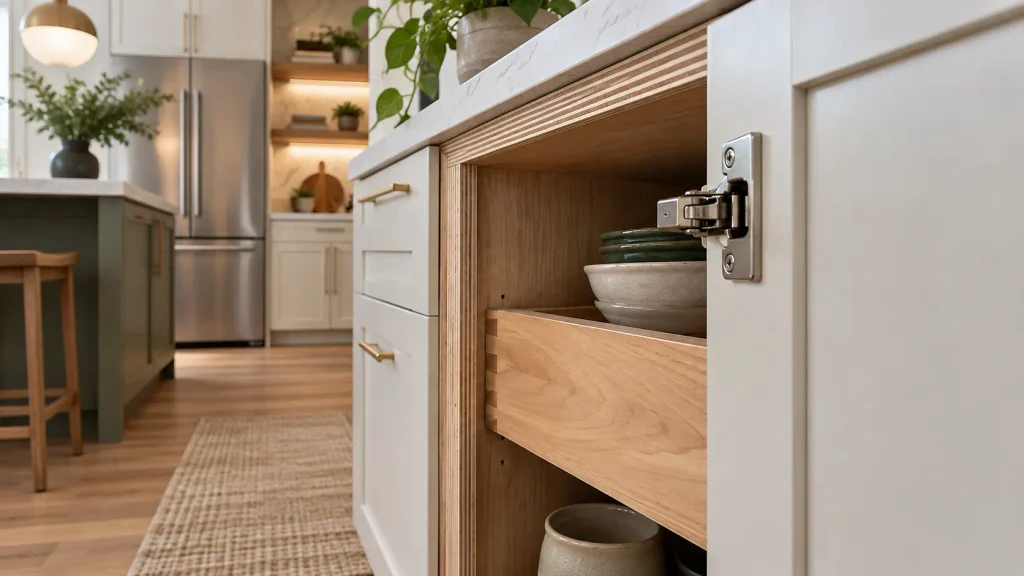
A well built cabinet box uses full plywood sides, a solid back panel, and corners that are joined with real fasteners rather than staples alone. Doors and drawer fronts should sit flush and close evenly, without gaps that widen over time.
Signs Of Weak Joints And Hardware
Cheap hinges wear out fast and start to sag within a year or two of daily use. Drawer glides that stick, rattle, or do not fully extend are another red flag. If a cabinet feels light for its size, that is often a sign of thinner material or a hollow frame rather than a solid box.
Mistake 3: Ignoring Moisture And Humidity Risk
A kitchen is one of the harshest rooms in a house for cabinetry. Steam from cooking, water from the sink, and heat from the dishwasher all hit the cabinets closest to them every single day.
Why Kitchens Are Hard On Cheap Materials
Particle board and lower grade MDF are especially vulnerable to this kind of daily exposure. Once moisture gets past the surface laminate, swelling and warping usually follow, and neither one can be fully reversed. Plywood handles the same conditions far better because the wood grain itself resists water absorption.
Mistake 4: Overlooking The Real Warranty Coverage
Discount sellers advertise low prices, but warranty coverage is where a lot of the real difference shows up. A materials warranty from the manufacturer only covers defects in the product itself. It says nothing about the labor if something needs to be reinstalled or adjusted.
A separate workmanship warranty on the installation is what protects a homeowner if a door starts sagging or a seam opens up after the crew leaves. This is one of the most common kitchen remodeling mistakes Cleveland homeowners make, assuming that “warranty” means the same thing no matter who sells the cabinets.
Mistake 5: Forgetting To Add Up The Hidden Costs
The sticker price on a discount cabinet rarely includes everything it takes to get a finished kitchen.
Delivery, Assembly, And Fitting Costs
Shipping, assembly time, hardware, and professional installation are usually priced separately from the cabinets themselves. For RTA (Ready To Assemble) boxes, assembly alone can take a full weekend or more for a full kitchen if it is not done by a professional crew. Fitting issues are common too, since stock sizes do not always match an existing kitchen’s layout exactly.
Homeowners who skip this step often end up spending close to what a properly quoted project would have cost anyway, just with more surprises along the way. It is also worth remembering that kitchen updates carry real long term value. Minor kitchen projects commonly return a large share of their cost at resale, often close to what the homeowner originally spent, which makes getting the construction right the first time even more worthwhile.
Mistake 6: Skipping A Professional Measure And Design Check
The last mistake is the one that causes the most rework. Ordering cabinets before a professional has measured the actual space almost always leads to gaps, mismatched fillers, or cabinets that simply do not fit.
Why Kamm’s Corners Homes Need An Accurate Layout
This matters even more in older neighborhoods. Kamm’s Corners is full of bungalows, ranches, and Colonials that are decades old, and kitchens in homes like these rarely match the standard modern dimensions that stock cabinet lines are built around. A homeowner near Rocky River Dr and Munn Road working from generic measurements can easily end up with a cabinet run that is an inch or two off in either direction.
Sitting down with a designer for an accurate measure and a real layout, rather than guessing from a stock size chart, is the single biggest factor in whether custom kitchen cabinets actually fit the way they should. Cleveland Cabinets has completed 8,000+ kitchen designs since 2015, and a proper measure is the first step in every one of them.
How To Shop Smarter For Discount Kitchen Cabinets
None of this means discount kitchen cabinets are automatically a bad choice. It means the term needs to be unpacked before a decision gets made.
Shopping smarter starts with slowing down. Most of the mistakes above happen because a homeowner compares one price tag to another without ever comparing what sits behind either number. A few extra minutes of research before ordering almost always costs less than fixing a warped panel or a mismatched drawer front six months later.
Seeing and touching the actual cabinet box matters more than any spec sheet or online listing photo. A sample door or a floor model shows the weight, the finish, and the hardware feel in a way that a product page never can. If a seller cannot show a real sample in person, that alone is worth asking about before moving forward.
Get the details in writing, not just in conversation. Delivery timelines, what the workmanship warranty actually covers, and whether assembly or installation is included should all appear on the quote itself. A verbal assurance is easy to forget once the sale is made, but a written quote holds everyone to the same terms.
Finally, treat the measure and the design step as part of the purchase, not an optional extra. A short visit to a design showroom, where an actual designer walks through the layout with real dimensions, tends to surface fit issues and material questions long before they turn into an installation day problem.
Questions To Ask Before You Buy
- Is the cabinet box plywood, MDF (Medium Density Fiberboard), or particle board?
- What does the workmanship warranty cover, separate from the materials warranty?
- Are delivery, assembly, and installation included in the price or billed separately?
- Has anyone actually measured the kitchen, or are the sizes based on a standard layout?
- What happens if a drawer or door needs to be replaced two years from now?
Asking these five questions and taking the time to see the cabinets in person at a local showroom before ordering anything solves most of the mistakes covered above. Getting a hands-on look lets you inspect the finish quality, feel the hardware, and test drawer glides firsthand, ensuring your final selection holds up both visually and functionally in your home.

Comparing Quotes Apples To Apples
A lower total price is not always a lower cost once the full scope is compared. Two quotes can look close on paper while covering completely different things underneath.
Before comparing numbers, check that each quote includes the same box material, the same hardware, and the same delivery and installation terms whether you are buying custom options or browsing discount kitchen cabinets in a Cleveland showroom. A quote that leaves out assembly or installation will always look smaller than one that includes it, even if the finished job ends up costing the same either way.
It also helps to ask each seller the same five questions from the list above and write down the answers side by side. That single step turns a confusing price comparison into a clear one.
Knowing When To Call In A Professional
Not every kitchen needs a full custom design process, but some situations make that step much harder to skip. Odd angles, uneven walls, older plumbing, or electrical that has been moved over the years all make a standard size chart far less reliable.
Older housing stock, like much of what sits around Kamm’s Corners, tends to fall into this category more often than newer construction. A quick professional measure at that point is a small step that prevents a much bigger fitting problem once the cabinets arrive.
Serving the Kamm’s Corners Community and Beyond in Cleveland
Cleveland Cabinets works with homeowners throughout Kamm’s Corners and the surrounding west side of Cleveland. The neighborhood sits close to Impett Park, near the crossing of Rocky River Dr and Munn Road, around coordinates 41.4665471, -81.8146598 for anyone mapping the area.
Get Discount Kitchen Cabinets Kamm’s Corners Services Now
Navigate from Kamm’s Corners to Cleveland Cabinets Now
Frequently Asked Questions
What makes a kitchen cabinet a “discount” cabinet?
It usually refers to price point rather than a specific product. Discount kitchen cabinets can be RTA (Ready To Assemble) boxes, stock sizes from a retailer, or clearance pieces, and the materials inside vary widely between all three.
Are RTA cabinets the same as discount cabinets?
Not always, but the two categories overlap often. RTA (Ready To Assemble) simply describes how the cabinet ships and gets assembled. Some RTA lines use plywood boxes, while others use particle board, so the RTA label alone does not tell you the quality.
Can discount kitchen cabinets still be good quality?
Yes, if the box construction and hardware hold up to daily kitchen use. The price point is less important than confirming the material, the joinery, and the warranty coverage before buying.
How do I know if a cabinet is particle board or plywood?
Check the exposed edge of a shelf or the inside of a cabinet side. Plywood shows visible layers of real wood grain running in alternating directions. Particle board looks like compressed wood chips with no visible grain pattern.
What should I ask before buying discount kitchen cabinets in Cleveland?
Ask about the box material, the workmanship warranty, whether delivery and assembly are included, and whether the kitchen has actually been measured by a professional rather than estimated from a stock size chart.