
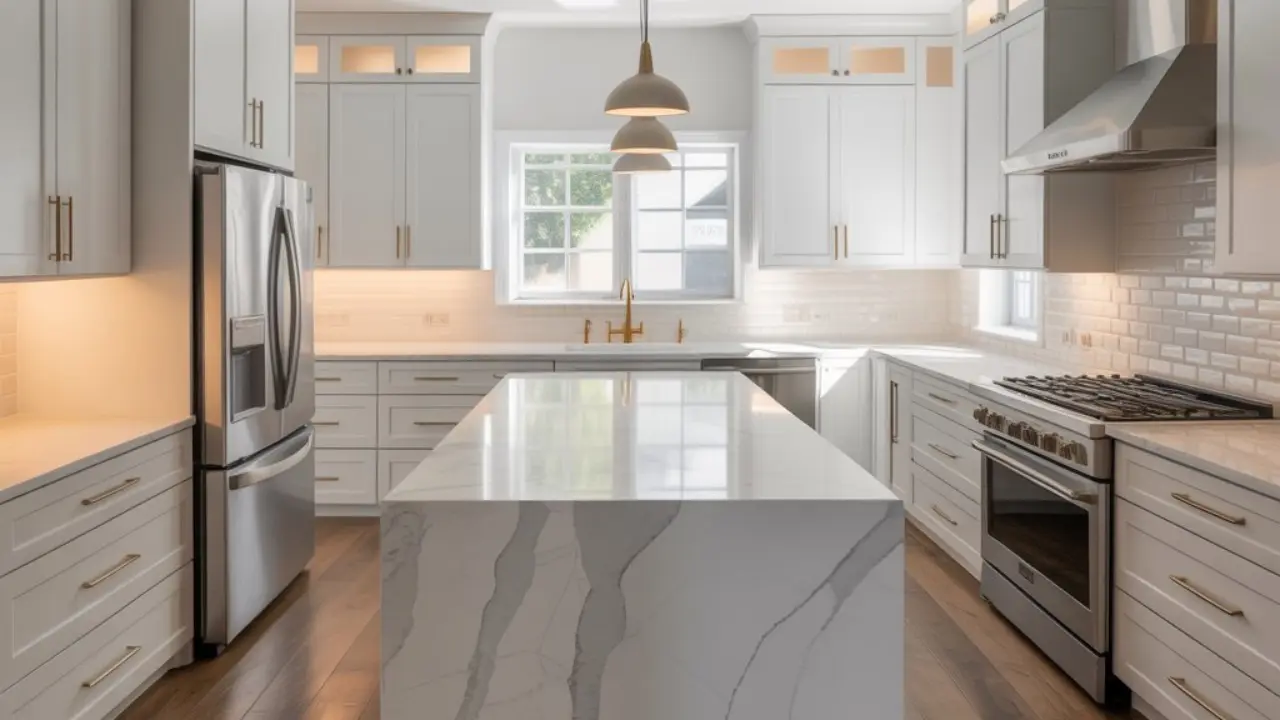
Most people walking into a kitchen remodeling project are thinking about countertops, cabinet styles, flooring options, and maybe a new appliance or two. Ventilation and air quality rarely make it onto the priority list until something goes wrong. A smoky kitchen after cooking, persistent cooking odors that drift into the living room, condensation building up on windows, or a chronic mustiness that no amount of cleaning seems to fix.
The kitchen generates more airborne pollutants than almost any other room in a typical home. Understanding how remodeling decisions directly influence ventilation performance and indoor air quality gives homeowners a genuinely more complete picture of what a renovation can accomplish beyond the purely visual transformation.
Why Kitchen Air Quality Matters More Than Most Homeowners Realize
Indoor air quality is a topic that tends to feel abstract until you start looking at what is actually in the air of a typical kitchen during and after cooking. The concentrations of certain airborne pollutants that occur during normal cooking activities can reach levels that would be considered concerning in outdoor air quality measurements, yet most homes have ventilation systems that are nowhere near adequate for the volume of pollutants being generated.
What Pollutants Are Generated in a Typical Kitchen
Cooking generates a surprisingly diverse mixture of airborne contaminants. Particulate matter is one of the most significant, produced whenever food is cooked at high heat. These fine particles, some of them small enough to penetrate deep into lung tissue, are generated in quantities that vary significantly depending on the cooking method, the type of food, and the temperature used.
Carbon monoxide is another concern in kitchens with gas cooking appliances. Even properly functioning gas burners produce some carbon monoxide during combustion, and burners that are out of adjustment or partially blocked can produce significantly elevated levels. Nitrogen dioxide is produced during gas combustion as well and has been associated with respiratory effects, particularly in children and people with pre-existing lung conditions.
Grease aerosols generated during frying and sauteing coat surfaces, contribute to the fine particulate load in kitchen air, and can carry volatile compounds that have their own health implications. Steam and water vapor from boiling and other moist cooking methods contribute to elevated indoor humidity, which creates conditions favorable for mold growth if the moisture is not effectively exhausted from the space.
How Poor Ventilation Affects the Entire Home Not Just the Kitchen
Here is something that many homeowners do not fully appreciate until they start thinking about air movement as a system. Air in an open plan home or any home with connected spaces does not stay conveniently in the room where it was generated. Cooking odors, moisture, particulate matter, and combustion gases move through doorways, hallways, and any connected spaces, distributing themselves through the home according to pressure differentials and airflow patterns.
A kitchen with inadequate ventilation does not just have a kitchen air quality problem. It has a whole-house air quality problem that manifests most obviously in the kitchen but spreads its effects much more broadly.
Cooking odors, moisture, particulate matter, and combustion gases move through doorways, hallways, and any connected spaces, distributing themselves through the home according to pressure differentials and airflow patterns. For a deeper understanding of how these design decisions shape indoor environments, it helps to look at how kitchen layouts, ventilation systems, and remodeling choices work together in practice, especially in discussions around the broader impact of remodeling on indoor air quality and airflow design.
The Relationship Between Kitchen Layout and Airflow
The physical layout of a kitchen has a significant and often underappreciated influence on how effectively the space can be ventilated. This is an aspect of kitchen design where remodeling offers opportunities that simple appliance replacement or cosmetic renovation cannot match.
How Kitchen Layout Changes During Remodeling Affect Natural Airflow
Natural airflow in a kitchen depends on the same principles that govern airflow everywhere else. Air moves from areas of higher pressure to areas of lower pressure, it rises as it is heated, and it follows the path of least resistance. A kitchen layout that creates dead zones where air movement is minimal will accumulate cooking byproducts in those zones even if the overall ventilation system is adequate for the space as a whole.
Kitchen layouts that position cooking surfaces against interior walls away from windows and with limited ceiling clearance around the range area tend to have more significant ventilation challenges than those where cooking surfaces are positioned with better access to exhaust pathways.
Why Wall Removal and Open Plan Design Changes Ventilation Dynamics
One of the most common kitchen remodeling moves of the past two decades has been the removal of walls to create open plan kitchen and living spaces. This change has significant and somewhat double-edged implications for ventilation and air quality.
On the positive side, an open plan layout typically increases the volume of air available to dilute cooking pollutants and often improves cross ventilation possibilities. The removal of a wall that was blocking airflow between the kitchen and an adjacent space with windows can dramatically improve the natural ventilation of the cooking zone.
On the negative side, removing the physical barrier between the kitchen and the living space means that cooking odors, smoke, steam, and fine particulate matter now have unobstructed access to the entire open living area.
How Range Hood Selection During Remodeling Transforms Air Quality
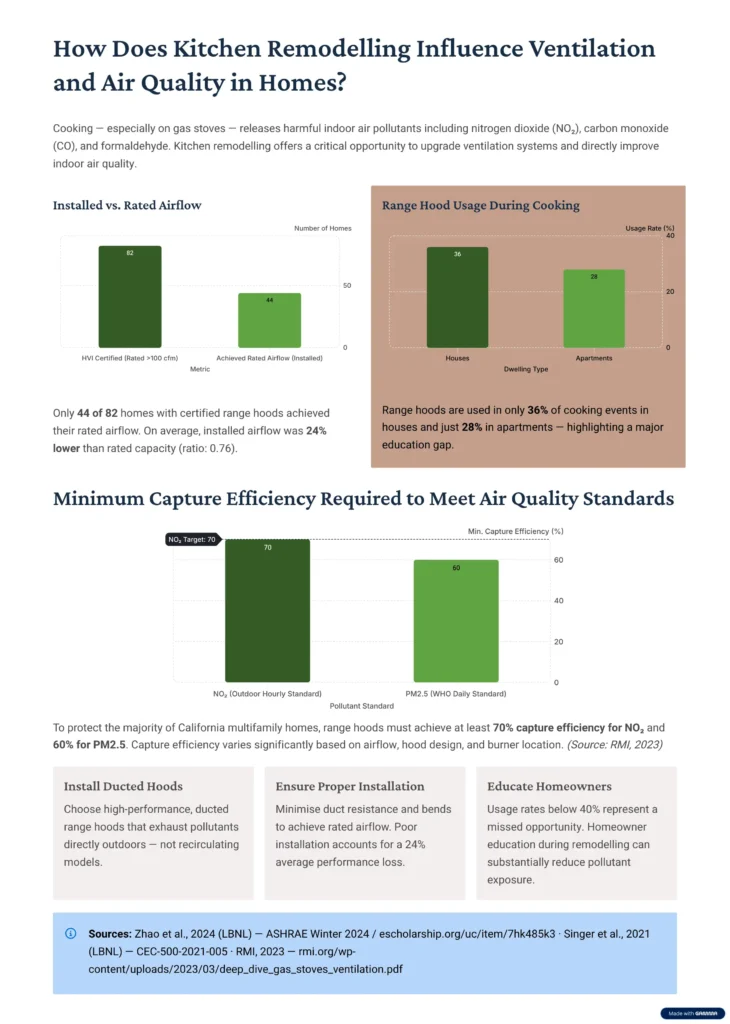
If there is a single remodeling decision that has the most direct and significant impact on kitchen ventilation and air quality, it is range hood selection and installation. A properly specified, correctly installed, and appropriately sized range hood does more to improve kitchen air quality than any other single element in the space.
Ducted vs Ductless Range Hoods and Their Air Quality Impact
The fundamental distinction in range hood technology is between ducted hoods that exhaust kitchen air to the outside of the home and recirculating hoods that filter kitchen air and return it to the kitchen. This distinction has enormous practical implications for air quality.
A ducted range hood, when properly sized and installed, physically removes cooking pollutants from the kitchen air and expels them outside. Particulate matter, grease aerosols, moisture, combustion gases, and odor compounds all leave the building. This is the most effective approach to kitchen ventilation from an air quality perspective because it addresses the pollution problem at the source and removes the contaminants from the living environment entirely.
A recirculating ductless range hood passes kitchen air through filters, typically charcoal filters for odors and mesh or baffle filters for grease, and returns the filtered air to the kitchen. This approach removes some of the grease aerosols and reduces odors, but it does not remove moisture, it does not remove fine particulate matter effectively, and it does not remove combustion gases.
One of the significant opportunities that kitchen remodeling provides is the ability to install a ducted range hood even in kitchens where one did not previously exist. Running ductwork during a remodel, when walls and ceilings may already be opened up for other work, is considerably more practical and cost-effective than attempting to add ducting as a standalone project.
How CFM Ratings Determine Ventilation Effectiveness
The CFM rating of a range hood, which stands for cubic feet per minute of air moved, determines how much kitchen air the hood can process in a given time period. Getting this number right for the specific kitchen is important because an undersized hood running at full capacity will still be inadequate, while an oversized hood can create pressure imbalances in the home that cause other problems.
The general guideline used in ventilation engineering is that a range hood should be able to exchange the air in the kitchen space approximately 15 times per hour. To calculate this, you multiply the volume of the kitchen in cubic feet by 15 and divide by 60 to get the required CFM. For a kitchen that is 12 feet by 15 feet with 9-foot ceilings, for example, this calculation suggests a minimum of approximately 405 CFM.
For gas ranges, which produce more combustion-related pollutants than electric cooking, higher CFM ratings are generally recommended. Professional-style gas ranges with high-output burners may require range hoods rated at 600 CFM or above to adequately capture the cooking exhaust they produce.
Why Range Hood Placement Relative to the Cooking Surface Matters
Even a properly rated range hood will underperform if it is not positioned correctly relative to the cooking surface. The physics of capture efficiency work like this: as cooking exhaust rises from the cooking surface, it spreads outward as it moves upward. The wider the exhaust plume becomes by the time it reaches the hood, the lower the percentage of pollutants the hood captures.
This means that the distance between the cooking surface and the hood inlet has a significant effect on capture efficiency. Standard installation guidelines typically recommend a mounting height of 24 to 30 inches above an electric cooktop and 24 to 36 inches above a gas range. Hoods mounted higher than these ranges will have meaningfully lower capture efficiency even if their CFM rating is adequate for the space.
How Remodeling Addresses Existing Ductwork Problems
Many homes, particularly older ones, have ductwork installed during original construction that has never been adequate for the cooking loads it was meant to handle, or that has developed problems over time that reduce its effectiveness.
Common Ductwork Issues Found During Kitchen Renovation
When kitchen walls and ceilings are opened during a remodel, it is common to discover ductwork issues that were invisible before the renovation began. Disconnected duct sections are among the most common findings. In older homes especially, flexible duct connectors can separate at joints over time, meaning the range hood has been exhausting directly into the wall cavity rather than to the outside.
Undersized ductwork is another common finding. The duct diameter required to efficiently move the CFM output of a modern range hood is larger than many homeowners expect. A 6-inch round duct is the minimum practical diameter for most residential range hood installations, and 8-inch or larger ductwork is appropriate for higher-capacity hoods. When a more powerful range hood is installed during a remodel to replace an older and less capable unit, the existing ductwork may need to be upsized to allow the new hood to perform to its rated capacity.
How New Duct Routing Improves Exhaust Efficiency
Duct routing, meaning the path that exhaust ductwork takes from the range hood to the exterior of the home, significantly affects how much of the hood’s rated capacity is actually delivered at the exhaust point. Each bend in a duct run reduces the effective CFM of the system because the air must change direction, creating turbulence and friction losses. Long duct runs with multiple bends can reduce effective CFM by 20 to 40 percent compared to the hood’s rated capacity.
During a kitchen remodel, there is an opportunity to plan duct routing that minimizes these losses. The ideal duct run is as short as possible and as straight as possible, with large-radius bends rather than sharp 90-degree turns wherever a direction change is necessary.
How Cabinet Reconfiguration Affects Kitchen Ventilation
Kitchen cabinets have a relationship with ventilation that goes beyond just providing a mounting location for the range hood. The configuration and placement of cabinets throughout the kitchen influences airflow patterns in ways that most homeowners never consider.
Why Cabinet Placement Around Cooking Zones Influences Airflow
Upper cabinets positioned immediately adjacent to a range or cooktop can act as physical barriers that deflect the rising cooking exhaust plume away from the range hood capture zone. This is particularly relevant when upper cabinets on either side of the range extend close to or past the front edge of the cooking surface. In this configuration, the cabinet faces create a channel that directs the exhaust plume forward rather than allowing it to rise naturally into the hood above.
A kitchen remodel that reconfigures the cabinet layout around the cooking zone, perhaps by creating more clearance at the sides of the range area or by adjusting the depth of adjacent upper cabinets, can improve range hood capture efficiency without any change to the hood itself.
How Soffit and Upper Cabinet Changes Improve Ventilation Access
Many older kitchens have soffits, the enclosed spaces between the tops of upper cabinets and the ceiling, that were built to conceal ductwork, plumbing, or structural elements. These soffits can restrict the airflow space above and around cabinets in ways that reduce natural convection currents in the kitchen. When soffits are removed during a remodel and the space between the cabinet tops and the ceiling is opened up, this creates additional air movement pathways that can improve the overall ventilation dynamics of the space.
The Role of Windows and Natural Ventilation in Kitchen Remodeling
While mechanical ventilation through range hoods and exhaust fans is the primary tool for managing kitchen air quality, natural ventilation through windows remains a valuable complement to mechanical systems and an important consideration in kitchen remodeling planning.
How Window Placement and Size Changes Affect Cross Ventilation
Cross ventilation, the movement of air through a space from one opening to another on opposite or adjacent walls, is the most effective form of natural ventilation. A kitchen with windows on two walls, or a window on one wall and a doorway to an adjacent space with windows on the opposite side, has the potential for effective natural ventilation when outdoor conditions are appropriate.
When a kitchen remodel includes changes to window placement or size, understanding how those changes affect cross ventilation potential is worthwhile. Adding a window on a wall that previously had none, enlarging an existing window, or changing from a fixed window to an operable one all improve natural ventilation capability.
Why Operable Windows Near Cooking Zones Are a Ventilation Asset
An operable window positioned near the cooking zone provides a direct path for cooking exhaust to exit the kitchen without relying entirely on the mechanical ventilation system. On mild days when outdoor air quality is good, opening a window near the range while cooking provides immediate dilution of cooking pollutants and direct exhaust of steam and odors.
How Appliance Upgrades During Remodeling Reduce Indoor Air Pollutants
Kitchen remodeling almost always involves some level of appliance replacement, and the appliance choices made during a remodel have direct implications for indoor air quality beyond just the ventilation system itself.
How Induction Cooktops Change the Ventilation Equation
Induction cooktops represent a fundamentally different approach to cooking heat compared to gas or conventional electric resistance burners, and their air quality implications are significant. Because induction cooktops generate heat through electromagnetic induction in the cookware itself rather than through combustion or a heated element, they produce no combustion gases.
There is no carbon monoxide, no nitrogen dioxide, and no combustion particulate matter associated with induction cooking. This does not eliminate the need for kitchen ventilation since food being cooked at high heat still generates particulate matter, grease aerosols, and odors regardless of the heat source. But it does remove a significant category of indoor air pollutant from the kitchen environment.
Why Dishwasher and Refrigerator Upgrades Affect Humidity Levels
Appliances beyond the cooking surface also have air quality implications. Older dishwashers typically use heated drying cycles that release significant quantities of steam into the kitchen when the door is opened at the end of a cycle. Newer dishwashers with condensation drying systems handle this moisture internally, releasing much less steam into the kitchen air during unloading.
Refrigerators affect kitchen humidity indirectly through their condenser coil operation. Older refrigerators with inefficient condensers run more frequently and generate more heat during operation than modern high-efficiency units.
How Flooring and Cabinet Material Selection Affects Indoor Air Quality
The materials used in kitchen construction and finishing contribute to indoor air quality through VOC emissions that occur during and after installation. This is an aspect of kitchen remodeling that is easy to overlook but genuinely relevant to the long-term air quality of the finished space.
VOC Emissions From Cabinetry and How to Minimize Them
Kitchen cabinets are one of the most significant potential sources of VOC emissions in a remodeled kitchen because they typically involve large surface areas of engineered wood products and finishing materials that can off-gas volatile compounds. The adhesives used in plywood and MDF construction, the finishes applied to cabinet surfaces, and the coatings on cabinet interiors all contribute to the VOC emission profile of the finished cabinet installation.
Formaldehyde is the most significant VOC concern in cabinetry, primarily because it is used in the urea-formaldehyde resins that bond the layers in many plywood and particleboard products. Selecting cabinets built with formaldehyde-free or low-formaldehyde adhesive systems, such as those using phenol-formaldehyde resins which emit at much lower rates, meaningfully reduces the long-term VOC load from cabinetry.
How Flooring Material Choice Influences Kitchen Air Quality
Flooring materials also have VOC emission profiles that vary considerably by material type. Vinyl flooring products, including luxury vinyl plank, use adhesive systems and surface coatings that can off-gas VOCs, particularly in the period immediately following installation. Selecting flooring products with third-party indoor air quality certifications such as FloorScore or GreenLabel Plus provides assurance that the product has been tested and meets established emission standards.
Solid hardwood flooring finished with water-based polyurethane generally has a lower VOC emission profile than solvent-based finish systems. Tile and natural stone flooring have minimal VOC emissions from the materials themselves, though the grout and adhesive systems used in their installation can contribute to short-term VOC levels that dissipate within days to weeks of installation.
How Lighting Changes During Remodeling Indirectly Affect Ventilation
There is an indirect but real relationship between kitchen lighting choices during a remodel and the ventilation performance of the kitchen. Traditional incandescent and halogen light fixtures generate significant heat during operation. That heat contributes to the thermal load in the kitchen, which affects the convection currents that carry cooking exhaust toward the range hood and influences the overall temperature differential that drives natural ventilation.
Replacing high-heat incandescent and halogen fixtures with LED lighting during a remodel reduces the thermal contribution of lighting to the kitchen environment. While this is primarily a benefit in terms of cooling load and energy efficiency, it also subtly changes the thermal dynamics of the kitchen airspace.
Kitchen Remodeling Cleveland and Regional Air Quality Considerations
In the context of kitchen remodeling in Northeast Ohio, the specific climate and housing characteristics of the region create some relevant considerations for ventilation planning. The significant seasonal temperature variation in the Cleveland area means that kitchens spend portions of the year in conditions where natural ventilation through open windows is not practical due to cold outdoor temperatures. During these periods, the mechanical ventilation system carries the entire ventilation load, making its proper sizing and installation even more critical.
The prevalence of older housing stock in the Kitchen Remodeling Cleveland market also means that many renovation projects involve replacing original ventilation systems, or adding ducted ventilation to kitchens that never had it, rather than simply upgrading existing adequate systems. Firms with deep experience in this regional housing stock, like Cleveland Cabinets and others working in the local kitchen renovation market, develop specific knowledge about the ductwork configurations, wall construction types, and layout patterns common in homes of different eras throughout the area.
Kitchen remodeling’s influence on ventilation and air quality is both broader and deeper than most homeowners appreciate when they begin planning a renovation. From the fundamental decision about range hood type and capacity through the routing of exhaust ductwork, the selection of low-emission cabinet and flooring materials, the reconfiguration of the kitchen layout to improve airflow patterns, and the choice of cooking appliances that reduce combustion pollutants, every major remodeling decision has implications for how well the finished kitchen manages the considerable air quality challenges that cooking creates.
FAQs
1. What is the most important ventilation improvement a kitchen remodel can make?
Installing or upgrading to a properly sized ducted range hood that exhausts to the outside of the home is the single most impactful ventilation improvement available in kitchen remodeling.
2. How do I know if my current kitchen ventilation is inadequate?
Signs of inadequate kitchen ventilation include persistent cooking odors that linger for hours after cooking, visible condensation on windows or walls during and after cooking, a sticky or greasy film developing on surfaces throughout the kitchen and adjacent spaces, and any visible smoke or haze remaining in the kitchen after cooking is complete.
3. Can a kitchen remodel improve air quality if I have gas appliances?
Yes, significantly. Upgrading to a properly sized ducted range hood is the primary improvement, as it captures and exhausts the combustion gases produced by gas cooking. Additionally, ensuring gas appliances are properly adjusted for complete combustion and considering a switch to induction cooking for some or all cooking tasks can meaningfully reduce indoor combustion pollutant levels.
4. How long do VOC emissions from new kitchen materials last?
VOC emission rates from newly installed kitchen materials are highest immediately after installation and decline over time as the volatile compounds off-gas and dissipate. For most standard cabinet and flooring products, emission rates drop significantly within the first few weeks.
5. Does switching to an open plan kitchen layout improve or worsen air quality?
It can do both depending on how the remodel is handled. An open plan layout increases the volume of air available to dilute cooking pollutants and can improve cross ventilation potential, both of which benefit air quality.