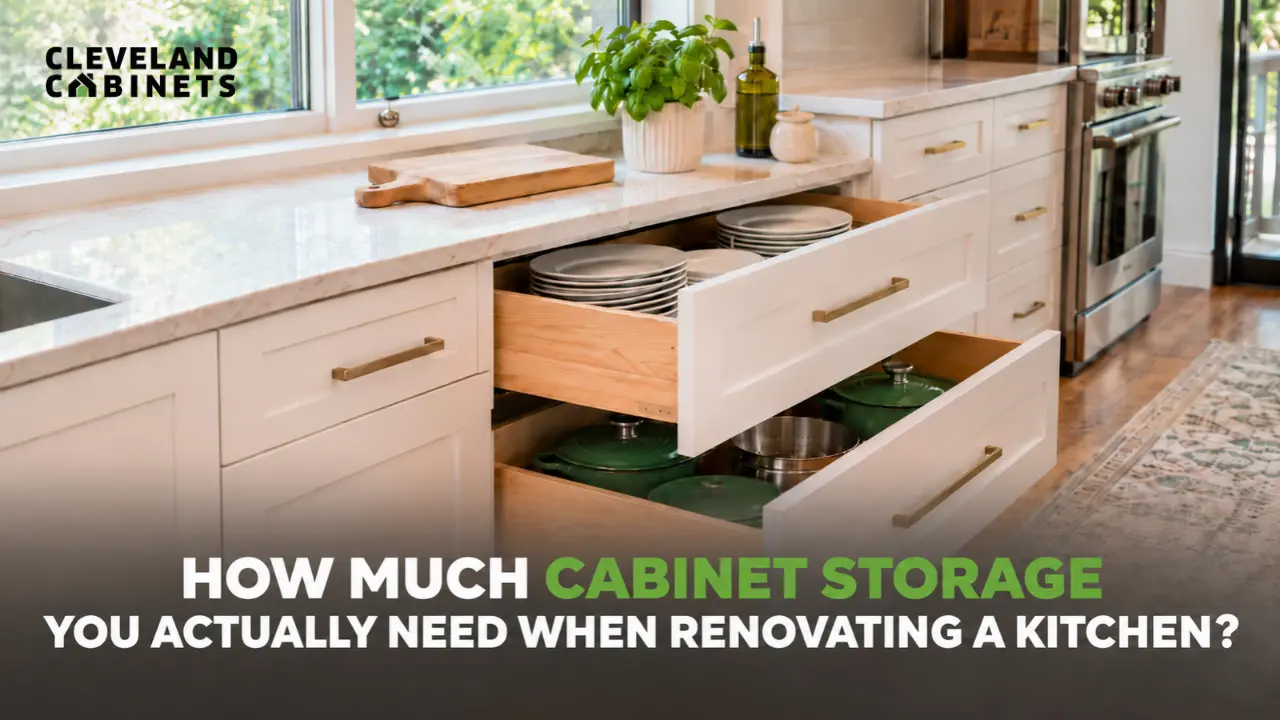

A showroom display kitchen can tell you a lot about cabinet quality, but only if you know where to look. The doors get the attention. The box, the drawers, the hinges, and the finish tell the real story. Here is how to read a display kitchen at a kitchen showroom in Fairview Park, one step at a time, so you leave with facts instead of impressions.
Most people walk into a display kitchen and look at the color. That is natural. Color is what you see first. It is also the least useful thing to judge from across the room.
Why Looks Alone Can Mislead You
Two cabinets can look the same from six feet away. They can feel very different after five years of daily use.
That gap is why a kitchen showroom Fairview Park visit is worth the drive. You can touch, open, and test what a photo can only suggest.
The goal is not to become a cabinet maker overnight. It is to learn a handful of simple checks that any homeowner can do in a few minutes.
What A Showroom Display Kitchen Is Actually Showing You
A display kitchen is a finished sample. Someone designed it, built it, and lit it so you can picture the result in your own home.
That makes it useful. It also means you are looking at the most flattering version of the cabinets.
A Display Kitchen Is A Sample, Not A Promise
Think of it the way you would think of a model home. It shows what is possible. It does not show what your kitchen will look like on its own.
Your layout, your walls, and your light will all be different. The display is a starting point for a conversation, not the final answer.
What You Can Learn In Ten Minutes
Quite a lot, if you slow down. In ten minutes you can open a cabinet, pull a drawer, swing a door, and look closely at an edge.
Those four checks tell you more about quality than any photo or brochure. The rest of this guide walks through each one.
Start With The Cabinet Box, Not The Door
Doors are the part you admire. The box is the part that does the work.
The cabinet box holds your dishes, your pots, and the weight of a stone countertop. If the box is weak, everything attached to it suffers.
Open A Base Cabinet And Look Inside
Open a base cabinet and look at the sides, the back, and the floor of the box. Press gently on a side panel. A good box feels solid and does not flex.
Look for a full back panel. Look for clean, tight corners. Notice whether the inside feels finished or rough.
A box that flexes in the showroom will flex in your kitchen too, only with a heavy load on top.
Plywood, Particleboard, And MDF In Plain Words
Three materials come up again and again. Here is what each one means.
Plywood is made of thin layers of wood glued together, with the grain alternating from layer to layer. That cross layering gives it strength and helps it resist moisture.
Particleboard is made of wood chips pressed together with glue. MDF (Medium Density Fiberboard) is made of fine wood fibers pressed into a smooth, dense panel. Both can perform well when they are well made and sealed.
Here is the part many guides skip. The material is only half the story. A well built particleboard or MDF box can outperform a poorly built plywood one. Joinery, thickness, and finish all matter too.
Framed And Frameless Boxes
You will see two basic box styles. A framed cabinet has a solid frame across the front of the box, and the doors attach to that frame. A frameless cabinet skips the frame, and the doors attach directly to the box.
Neither style is better in every kitchen. Framed cabinets give a classic look and a rigid front. Frameless cabinets give slightly more usable space inside each opening.
What matters is that the style you choose is built well. Ask the designer to point out how the box is joined at the corners, whichever style you prefer.
The Shelf Test
Shelves show quality quickly because they carry weight every day.
Buying guides commonly point to 3/4-inch plywood as the thickness to look for in shelves, because thinner particleboard shelves can sag over time.
Ask the designer to show you the shelf thickness. Rest a hand on a shelf and press lightly. You are looking for a shelf that feels firm, not springy.
Pull Every Drawer All The Way Out
Drawers get used more than almost anything else in a kitchen. They open and close dozens of times a day.
That is why drawers are one of the fastest ways to judge quality. Do not just pull a drawer halfway. Pull it all the way out and look closely.
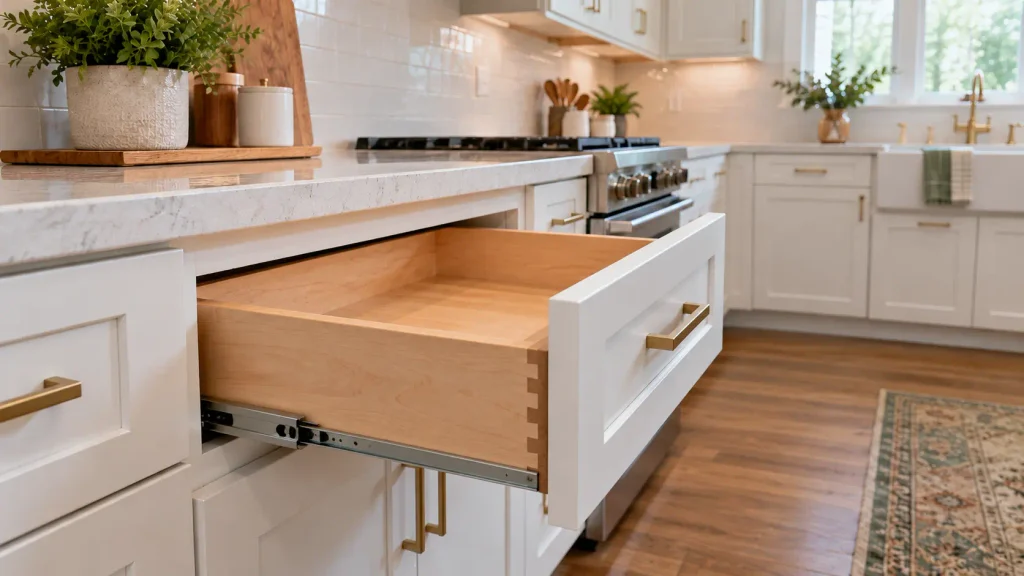
Look For Dovetail Joints On All Four Corners
A dovetail joint looks like interlocking teeth where the drawer front meets the sides. It locks the wood together mechanically.
Drawers held together with staples or glue alone tend to loosen with use. Dovetail corners hold up to heavy loads for years.
Check all four corners, not just the front. A good drawer is built the same way on every corner.
Check The Drawer Bottom And The Glides
Look at the drawer bottom. A sturdy one sits in a groove on all four sides, rather than being stapled on from underneath.
Then check the glides, the hardware that lets the drawer slide. Full extension glides let the drawer come all the way out, so you can reach the back.
Push the drawer closed with a little force. It should close smoothly and quietly, with no rattle and no sticking.
Check The Weight Of The Hardware
Pick up a drawer pull or door handle if one is on display. Cheap hardware feels light and thin. Good hardware feels solid in your hand.
Hardware is small, but you touch it more than any other part of the kitchen. It is worth a few seconds of attention.
Test The Doors, Hinges, And Alignment
Doors should look good, but they should also work well on the hundredth opening as much as the first.
A display kitchen gives you a rare chance to test that. Take it.
Open And Close Each Door Several Times
Open a door, then close it. Do it again. Do it ten times.
The door should swing smoothly and close without a bang. Soft close hinges add a gentle finish, though they are a comfort feature and not the whole measure of quality.
Look at the hinge itself. Many well made hinges have small adjustment screws. Those let an installer fine tune the fit of a door long after the first install.
Look At The Gaps Between Doors
Stand back and look at the lines between doors and drawer fronts. The gaps should be even from top to bottom and side to side.
Uneven gaps can point to a box that is not square or hinges that were never adjusted. Even gaps point to care in both the build and the installation.
Display kitchens get touched all day, so a little wear is normal. Look for patterns, not one scuff.
Read The Finish Up Close
The finish is the layer you touch every day. It also hides or reveals a lot about how a cabinet was made.
Do not judge a finish from five feet away. Walk up to it.
Edges, Corners, And Recessed Panels
Run a hand along the edge of a door. Look at the corners. Look into the recessed part of a panel door.
A good finish is even in all three places. Thin spots, drips, or rough patches usually show up at edges and in corners first.
Check the joint where the frame of the door meets the center panel. The seam should be tight and clean.
Sheen And Fingerprints
Sheen is how glossy or flat a finish looks. A flat, matte finish can show oils from hands more easily than a satin finish.
Touch a door around the handle area. Ask how the finish handles cleaning. A kitchen is a working room, and the finish needs to handle wiping and spills.

Compare Two Displays Side By Side
If the showroom has more than one display, compare them directly. Open the same type of cabinet in each one.
Notice which feels firmer, which closes more quietly, and which finish looks cleaner at the edges. Side by side, small differences become easy to see.
Take a photo of each one. Photos help later, when the details start to blur together.
What The Display Lighting Will Not Tell You
Showrooms are lit to look good. That is not a flaw. It is simply a fact to account for.
Your kitchen will have different light, different ceilings, and different shadows.
Showroom Light Versus Kitchen Light
Showroom lighting is often bright and even, with light hitting the cabinets from many angles. That softens shadows and can make colors look cleaner than they will at home.
In your kitchen, light may come from one window and a few ceiling fixtures. Under an upper cabinet, a finish can look darker and warmer.
A small sample chip also cannot show how shadows fall into a recessed panel. Scale matters. A color that looks light on a sample can feel heavy across a whole wall.
How To Check A Sample At Home
Ask to take a door sample home. Set it in your kitchen and look at it in the morning, at midday, and at night.
Hold it against your countertop, your flooring, and your wall color. If it still looks right in all three lights, you can feel good about the choice.
This one step prevents more regret than almost any other.
Questions To Ask While You Stand In The Display
A display kitchen is a good moment to ask questions, because you can point at what you mean. Bring a short list.
- What is the cabinet box made of, and how thick is it?
- How are the drawer corners joined?
- What type of hinge and glide does this door and drawer use?
- How is the finish applied, and how do I care for it?
- What does the manufacturer warranty on materials cover?
- What does the workmanship warranty on installation cover?
Write down the answers. Take a photo of the construction details if the showroom allows it. If you are still sorting out your wish list, our guide on questions to ask before starting a kitchen remodel can help you get ready.
A designer who can answer these questions plainly is a good sign. A designer who avoids them is also telling you something.
Cleveland Cabinets has 120+ reviews, so you can read what other homeowners say about the process before you ever visit.
How To Take Notes So The Visit Pays Off
A display kitchen holds a lot of information, and memory fades fast. A simple note system keeps the facts straight.
Write the door style name, the finish name, and the construction details the designer mentions. Add a quick note on how each drawer and door felt. Mark anything you want to ask about again.
Those notes make your next conversation faster. They also help you compare what you saw in the showroom with the design you eventually approve.
What A Display Cannot Show: Your Own Kitchen
Even a well built display kitchen cannot answer the question that matters most. How will these cabinets work in your space?
Your ceiling height, your window placement, and your plumbing all shape the layout. A display cannot account for any of them.
Layout, Measurements, And 3D Renderings
That is where a designer comes in. Design at Cleveland Cabinets is a paid professional service, and it includes 3D renderings of your actual kitchen.
A rendering lets you see the layout before anything is built. You can catch a crowded corner or a tight walkway early, while changes are still simple.
Cabinets are supplied and installed, which means one team handles the work from the first conversation to the last door. Cabinets are also on display and in stock at the Fairview Park showroom, so you can open and handle them in person.
From Display Kitchen To Finished Kitchen
A display kitchen is step one. Here is how the path usually continues.
First comes a conversation with a designer about how you cook, store, and live in your kitchen. Next comes a budgetary estimate, a preliminary scope that helps you choose materials that fit your budget. Financing options are available for homeowners who want to spread out the project.
After that comes a home visit for exact measurements, and then the final design with 3D renderings. Only then do the materials get finalized.
The Typical Kitchen Remodel Timeline
Once the design is final, a typical kitchen remodel takes about 4 to 8 weeks. Your own timeline is confirmed in writing before work begins.
A typical kitchen remodel with Cleveland Cabinets runs 4 to 8 weeks.
Installation is licensed and insured. Materials carry manufacturer warranties, and the installation carries a workmanship warranty. Award winning designers guide the process from the first sketch to the final walkthrough.
For homeowners planning kitchen remodeling in Fairview Park, the display kitchen is a good place to start learning what quality looks like.
Cleveland Cabinets Serving the Kamm’s Corners Community and Beyond in Fairview Park
Cleveland Cabinets welcomes homeowners from Kamm’s Corners and across Northeast Ohio who want to see cabinets in person. Homeowners around Impett Park, near the crossing of Rocky River Dr and Munn Road at coordinates 41.4665471, -81.8146598, can make the short drive to the kitchen showroom Fairview Park to compare cabinets in person.
Get kitchen showroom Kamm’s Corners services now, whether you are still collecting ideas or ready to sit down with a designer.
Navigate from Kamm’s Corners to Cleveland Cabinets Now
Frequently Asked Questions
How can you tell if kitchen cabinets are good quality in a showroom?
Start with the box, then the drawers. Look for a solid, non flexing box, dovetail drawer corners, smooth glides, even gaps between doors, and a finish that is consistent at the edges and corners.
Does plywood always mean better cabinets?
Not always. Plywood is strong and resists moisture, but a poorly built plywood box can still fail. Joinery, thickness, and finish matter just as much as the material.
Should you open the drawers and doors in a display kitchen?
Yes. A display kitchen is meant to be handled. Open every door and pull each drawer all the way out, so you can judge how they feel and sound.
Is a showroom display kitchen the same as the cabinets you will receive?
A display shows a style, a finish, and a level of construction. Ask the designer to confirm the exact door style, finish, and construction details for your project, and to put them in writing.
Can you tell if a kitchen fits your budget from a display kitchen?
No. A display shows materials, not your project. The budgetary estimate step is where a designer builds a preliminary scope that helps you choose materials that fit your budget.