

Refacing sounds like the easy fix for tired kitchen cabinets, and sometimes it is. But refacing only covers the doors, drawer fronts, and exposed panels, so a cabinet box with real damage underneath will still fail no matter how nice the new doors look. Here are seven signs that your kitchen deserves a full replacement instead of a surface level refresh.
What Separates a Cabinet Refacing From a Cabinet Replacement
Refacing keeps the existing cabinet boxes in place and replaces what you see: new doors, new drawer fronts, and a fresh veneer applied over the exposed sides and frames. It is a cosmetic update, not a structural one. Replacement removes everything, boxes included, and starts over with new joinery, new hinges, and a layout built around how you actually use the kitchen today.
The two approaches solve different problems. Refacing works when the boxes are sound and the layout still makes sense. Replacement is the right call when the boxes themselves, the drawers, or the way the kitchen flows have already failed. Knowing which one your kitchen needs starts with looking past the doors and paying attention to the boxes, the hinges, and the drawers underneath.
Most homeowners never open a cabinet door looking for problems until something already feels off, a drawer that sticks, a smell that will not go away, or a door that no longer closes flush. By the time those small annoyances show up, the underlying issue has usually been building for months or even years. Walking through each of the seven signs below with a critical eye, rather than assuming a fresh coat of paint or a new door will solve everything, is the fastest way to find out which category your kitchen actually falls into.
Sign 1: Water Stains, Swelling, or a Soft Feel Inside the Cabinet Boxes
Open the doors under your sink or around the dishwasher and look closely at the bottom panel and the sides. Dark stains, a swollen or bubbled surface, or a soft spot that gives slightly when you press on it are all signs that moisture has already gotten into the cabinet box. Cabinet boxes built from MDF (medium-density fiberboard) or particleboard absorb water quickly, and once they swell, the shape does not go back.
This matters because refacing only touches the surface. New doors and a new veneer over a swollen box will not stop the swelling from spreading, and covering it up can hide a mold problem instead of solving it. If you find water damage in more than one cabinet, or if the smell of mildew lingers even after cleaning, that box needs to come out. A designer can confirm how far the damage has spread during a walk-through, but water damage inside the box is one of the clearest signs replacement is the safer choice.
Sign 2: Drawers That Keep Falling Off Track No Matter How Many Times They Are Adjusted
A drawer that sticks once in a while is normal wear. A drawer that keeps falling off its slides, no matter how many times the track gets tightened or realigned, usually means the drawer box itself has failed. Well-built drawer boxes use joinery like dovetail or dado joints, where the pieces interlock and hold their shape for decades. Cheaper drawer boxes are often glued and stapled, and those joints loosen with repeated use until the whole drawer racks out of square.
Once a drawer box has racked out of square, no amount of slide adjustment will fix it permanently. You can replace the hardware, but the box will keep pulling itself apart because the underlying joinery has given out. If this is happening in more than one drawer across the kitchen, it is a sign of the overall build quality, not a single bad hinge, and it points toward replacement rather than a refacing job that leaves the same drawer boxes in place.
Sign 3: Doors and Hinges That Keep Failing After Repeated Repairs
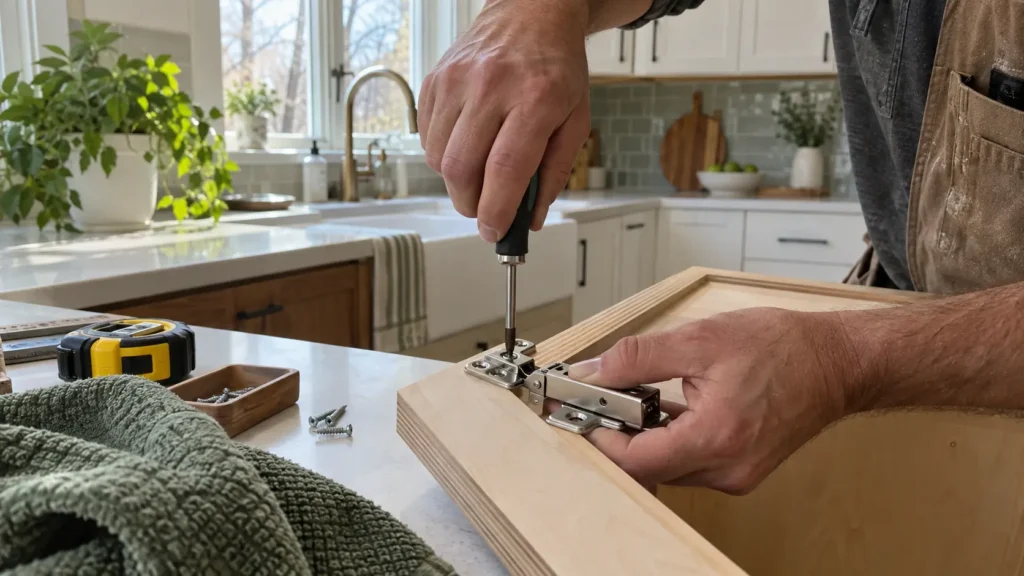
Soft close hinges are supposed to last for years of daily use. When hinges keep loosening, stripping out of the wood, or failing again shortly after being replaced, the problem is usually the material behind the hinge, not the hinge itself. Screws driven into particleboard or into a frame that has already been drilled and redrilled several times lose their grip, and no amount of new hardware will hold in a stripped hole.
The same applies to doors that no longer sit flush, sag on their hinges, or have visible gaps at the corners. If a door has been rehung two or three times and the problem keeps coming back, the frame behind it has likely lost its structural integrity. Refacing swaps the door for a new one, but it cannot rebuild a frame that no longer holds a screw. That is a job for full replacement.
Sign 4: A Layout That No Longer Works for How You Actually Cook
Sometimes the cabinets themselves are in fine shape, but the layout stopped working years ago. Maybe the refrigerator has grown too large for its space, the stove moved when the kitchen was last updated, or you simply need an island, a pantry wall, or more counter space near the sink. Refacing changes the finish, not the footprint. The cabinets stay exactly where they are.
If you find yourself working around your cabinets instead of with them, reworking corners that waste space, or wishing for a completely different traffic flow through the kitchen, that is a layout problem that only a full cabinet replacement can solve. A kitchen designer can map a layout built around your actual routine, from where the coffee station sits to how many people can move through the space at once, and that kind of change is simply outside what a refacing project is built to do.
Storage is often part of the same problem. Corner cabinets that waste half their depth, a single narrow pantry cabinet trying to hold everything from cereal to small appliances, or upper cabinets set too high to reach without a step stool are all layout issues baked into the original box placement. Refacing cannot add a pull out shelf where a fixed one currently sits, and it cannot turn a wasted corner into usable storage. Those changes require new boxes built to the dimensions of the space you actually have.
Sign 5: Cabinet Boxes Built From Materials That Were Never Meant to Last
Not every cabinet box is built the same way, and the material underneath the finish has a direct impact on how long it holds up.
Well-built kitchen cabinets typically last 20 to 50 years, but boxes made from basic particleboard or thin MDF often need replacing in as little as 10 to 15 years.
Plywood boxes hold screws better, resist moisture longer, and keep their shape under the weight of dishes, pots, and pans stacked inside them for years. Solid wood performs well too, especially for face frames and doors, though it costs more and can expand or contract slightly with humidity. If a home inspection or a designer’s walk-through turns up boxes built from the cheapest available material, refacing only delays the inevitable. The box will keep failing at the same rate it always has, just with a nicer door bolted to the front of it.
Sign 6: Visible Structural Damage When You Open a Door or Pull Out a Shelf
Sagging shelves, cracked side panels, a bottom panel that has separated from the frame, or a cabinet that shifts when you lean on the counter above it are all signs of structural failure. This kind of damage usually shows up gradually, starting with a shelf that bows slightly under weight and ending with a panel that has fully pulled away from the frame.
Structural damage like this cannot be fixed by refacing, because refacing does not touch the internal frame or the load-bearing parts of the box. If you notice movement, cracking, or separation anywhere in the cabinet structure, especially in base cabinets that carry the weight of countertops and appliances above them, that is a sign the box has reached the end of its useful life and needs to be replaced rather than dressed up.
Sign 7: A Kitchen That Has Outgrown Every Update Already Made Around It
If you have already replaced the countertops, updated the flooring, or swapped in new appliances, and the cabinets are the one piece that still looks and feels dated next to everything else, that mismatch is worth paying attention to. Cabinets that were installed decades before the rest of the kitchen was updated are often reaching the end of their structural life at roughly the same time their style has fallen out of step with the room around them.
In cases like this, a refacing job can leave you with a kitchen that looks slightly better but still does not match the newer countertops, hardware, or flooring in finish or proportion. Full replacement lets every element of the kitchen, cabinets included, get designed together, so the finished space reads as one coordinated room instead of a patchwork of updates made years apart.
Refacing vs Replacing: A Quick Way to Decide Which One Your Kitchen Needs
If none of the seven signs above apply to your kitchen, refacing may still be a smart, lower disruption way to update the look of your cabinets. If even one or two of them do apply, especially water damage, structural failure, or a layout that no longer works, replacement is usually the better long term investment.
When Refacing Still Makes Sense
Refacing works best when the cabinet boxes are structurally sound, dry, and free of cracks or separation, and when you are happy with the current layout of the kitchen. It is a faster, less disruptive project than a full replacement, since the boxes and their locations stay exactly as they are.
Refacing can add another 10 to 15 years of life to a cabinet box that is still structurally sound, though it cannot fix water damage, warping, or a layout that no longer works.
When Replacement Is the Smarter Investment
Replacement is the right call whenever the boxes show water damage, structural cracking, drawers that keep failing, or hinges and screws that no longer hold. It is also the better option any time the layout itself needs to change, since refacing cannot move a cabinet, widen a walkway, or add storage where none exists today. A budgetary estimate during a showroom visit is the easiest way to see how a full replacement compares to a refacing project for your specific kitchen.
What a Kitchen Designer Looks for During a Cabinet Evaluation
A kitchen designer evaluating your cabinets is looking past the surface for exactly the signs covered above: moisture inside the boxes, joinery that has loosened, hinges and screws that no longer hold, and a layout that no longer matches how the kitchen gets used day to day. That evaluation is the starting point for a paid, professional design process that includes a 3D rendering of the finished space, so you can see the layout and finishes before anything is built.
Homeowners who have already gone through a full evaluation sometimes find that only part of the kitchen needs replacing, while other sections are still sound enough to reface. A designer walking through a kitchen will typically open several base cabinets near the sink and dishwasher first, since that is where moisture damage shows up earliest, before checking drawer boxes, hinge screws, and the overall layout against how the family actually uses the space day to day.
A 9 Kitchen Remodeling Mistakes Cleveland Homeowners Make and How to Avoid Them covers several planning missteps that show up during this same evaluation stage, and it is worth a read before any decision gets made about kitchen cabinets in your own home. Bringing a list of frustrations, from a drawer that never opens smoothly to a corner that never gets used, into that first conversation helps the designer prioritize what actually needs to change.

How Cleveland’s Older Housing Stock and Weather Affect Cabinet Lifespan
Northeast Ohio’s seasonal humidity swings, from damp spring thaws to dry winter heating, put real stress on cabinet materials over time, especially in homes built decades ago with builder grade cabinet boxes. Older housing stock around Kamm’s Corners and similar west side Cleveland neighborhoods often still has its original cabinets, sometimes 30 or 40 years old, and those boxes were rarely built with the moisture resistance that plywood or solid wood construction provides.
That combination, older materials plus decades of humidity changes, is exactly why so many kitchen cabinets Cleveland homeowners are evaluating today show more than one of the seven signs above at once. A cabinet box that has absorbed seasonal moisture for thirty years is a very different evaluation than one that is five years old with a single water stain, and a local designer who has walked through hundreds of Northeast Ohio kitchens can usually tell the difference at a glance.
Basements and slab foundations common to this part of Cleveland also play a role, since ground-level moisture can wick upward into lower kitchen cabinets over time, especially near exterior walls. None of that means every older kitchen needs a full replacement, but it does mean a proper evaluation matters more here than it might in a newer build where the cabinets and the house are roughly the same age.
Cleveland Cabinets has completed more than 8,000 kitchen designs, one industry statistic worth knowing when you are comparing who to trust with a full cabinet evaluation.
Cleveland Cabinets Serving the Kamm’s Corners Community and Beyond in Cleveland
Cleveland Cabinets works with homeowners throughout Kamm’s Corners and the surrounding Cleveland area, just down the road from Drakefield Park and close to the corner of Lorain Ave and Rocky River Dr, at coordinates 41.4515471, -81.8146598. Homeowners in this pocket of the city often reach out after noticing one or more of the seven signs above in a kitchen that has not been touched in decades.
Get kitchen cabinets Kamm’s Corners services now by scheduling a showroom visit and a budgetary estimate to see whether your kitchen needs a full replacement or a simpler refacing job.
Navigate from Kamm’s Corners to Cleveland Cabinets Now
Frequently Asked Questions
How do I know if my kitchen cabinets need to be replaced instead of refaced?
Check inside the boxes for water stains, swelling, or a soft feel, and check the drawers and hinges for repeated failures. If any of those show up, replacement is usually the safer long term choice over refacing.
Can water damaged cabinet boxes be repaired instead of replaced?
Minor surface moisture can sometimes be dried out and sealed, but boxes that have swollen, softened, or developed mold usually need to be replaced, since the material itself has already lost its structural strength.
How much does it cost to replace kitchen cabinets versus refacing them?
Cost depends on the size of the kitchen, the materials chosen, and how much of the layout is changing. A showroom visit and budgetary estimate is the best way to compare both options for your specific space.
How long does a full kitchen cabinet replacement take from start to finish?
A typical kitchen remodel runs 4 to 8 weeks from the start of installation, though the design and ordering process before that can add additional time depending on the materials selected.
Is it worth replacing kitchen cabinets in an older Cleveland home near Kamm’s Corners?
For homes with original cabinets that are decades old, replacement often makes more sense than refacing, especially if the boxes show any of the seven signs covered in this guide.