

A cabinet warehouse can look like the fastest way to a finished kitchen. Rows of stock boxes, sample doors mounted at eye level, and a price that seems easy to plan around. But the parts that decide how long a kitchen actually lasts are hidden behind the door, not printed on the tag. This guide walks through exactly what to check before you commit to anything at a cabinet warehouse in Cleveland, so the kitchen you bring home holds up the way it looked on the day it was installed.
Why Cabinet Quality Is Easy to Miss at a Warehouse
Warehouse shopping moves fast. Aisles of boxed cabinets, sample doors on display, and a salesperson focused on style and price.
None of that tells you what the box is actually made from.
The door style is the easiest thing to judge and the least important thing for durability. A shaker door on a stapled particleboard box looks the same on day one as a shaker door on a plywood box with dovetail joints. The difference shows up two years later, when drawers start to sag and hinges loosen.
The Showroom Floor Tells You Less Than You Think
Display models get handled carefully and replaced often. The box that ships to your kitchen may share nothing with the display model except the door style and finish colour. That is exactly why the checks below focus on what you can open, pull, and press, not what you can see from three feet away.
More than 8,000 kitchen designs completed across Northeast Ohio point to the same pattern: cabinets that fail early almost always trace back to the box, not the door.
Start With the Box, Not the Door
Professionals call it “reading the box.” Before anything else, open a base cabinet and look closely at the sides, the back, and the bottom panel.
Plywood vs Particleboard vs MDF
Plywood is layered wood veneer, and it holds screws, resists moisture, and stays square far longer than particleboard or medium-density fiberboard (MDF). Particleboard is compressed wood chips and glue. It costs less to produce, and it is also the material most likely to swell or sag once a kitchen sees real humidity and daily use. MDF sits in between: it machines cleanly for painted doors, but it is not a substitute for a plywood box.
Ask directly what the box is made from. “All-wood construction” is not a real answer, since particleboard and MDF are technically wood products too. Push for one of three words: plywood, particleboard, or MDF.
How Thick Should the Panels Be
Panel thickness matters as much as material. Look for box sides between five-eighths and three-quarters of an inch. A panel that flexes when you press on it is a sign the manufacturer built to a price point rather than a lifespan.
Pull Out a Drawer Before You Decide Anything Else
If there is one habit worth building at a cabinet warehouse, it is this: open a drawer and pull it all the way out.
Dovetail Joints vs Stapled Corners
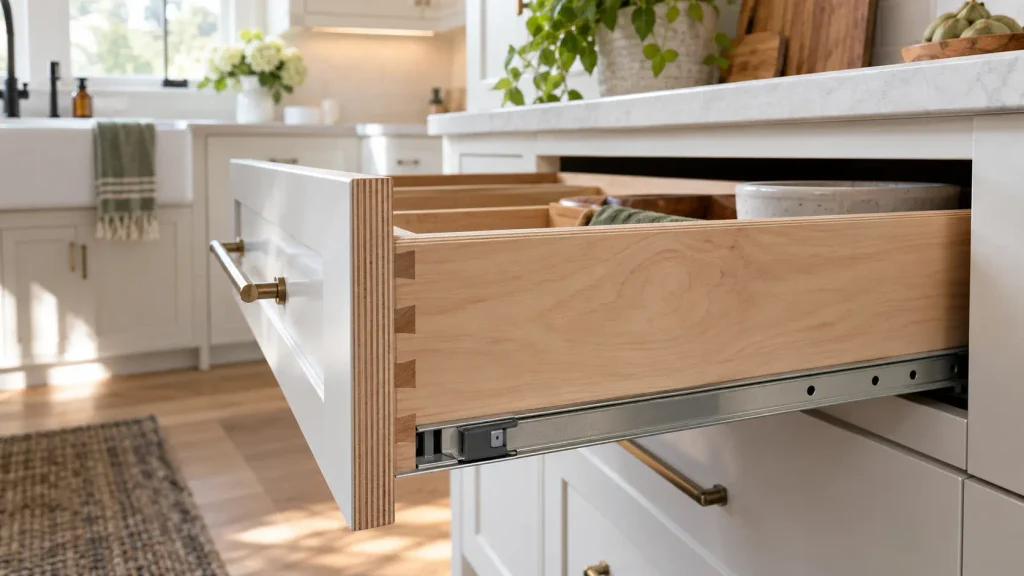
Look closely at the corners. Dovetail joints, the interlocking, tooth-shaped pattern woodworkers have used for centuries, lock the drawer sides and front together mechanically. They resist the daily pulling and weight a drawer takes on for decades. Stapled or glued corners loosen much sooner, and a loose drawer box is usually the first thing to fail in a kitchen.
Drawer Slides: Full Extension and Soft Close
Push the drawer back in, then pull it out again. Full-extension slides let the whole drawer clear the cabinet, so nothing gets lost at the back. Soft-close glides stop the drawer from slamming, and they are a reliable sign that the rest of the hardware line was built to the same standard.
Check the Hinges and Hardware
Hardware gets less attention than doors, but it fails more often.
Soft-Close Hinges
Open and close a door a few times. Adjustable, soft-close hinges should feel controlled, never loose or gritty. Cheap hinges tend to sag within the first year, which throws the door out of alignment with the cabinets next to it.
Hardware Grade and Weight Rating
Ask what weight rating the hinges and slides carry. A base cabinet holding pots and small appliances puts real strain on hardware every day, so a higher weight rating is worth the small cost difference over the life of a kitchen.
Look at the Finish Up Close
Step back from the aisle lighting and look at the finish under a window or a flashlight.
Painted Wood vs Thermofoil
Painted solid wood and MDF doors show grain or a smooth painted surface with visible brush or spray texture up close. Thermofoil is a vinyl laminate heat-pressed onto MDF. It looks similar to paint from a distance, but it can peel at the edges over time, especially near heat sources like a range or a dishwasher vent.
Signs of a Rushed Finish
Run a hand along an edge. Rough spots, uneven sheen, or visible seams at the corners usually mean the finish was rushed to keep pace with warehouse turnover. A clean finish should look and feel consistent across every door in the display.
A typical kitchen remodel in Northeast Ohio runs 4 to 8 weeks from order to installation, which is worth remembering when a warehouse offers same-day pickup instead.
Ask About Certification and Warranty
Two cabinet lines can use nearly identical marketing language and still be built to very different standards.
What Cabinet Certification Testing Involves
Industry certification testing puts a cabinet line through repeated door and drawer cycles, weight loading, and moisture exposure before it can carry a certification label. A line that has passed this testing has at least been checked against a consistent standard, rather than relying only on the manufacturer’s own claims. If a warehouse cannot tell you whether a line is certified, that is worth noting on its own, alongside the common kitchen remodeling mistakes that tend to compound once a kitchen is already underway.
Manufacturer Warranty vs Workmanship Warranty
A manufacturer warranty covers the cabinets themselves: materials, hardware, and finish defects. A workmanship warranty covers the installation, whether the cabinets were leveled, secured, and finished correctly once they left the box. Ask about both separately, because a strong manufacturer warranty does not cover a poor installation, and the reverse is also true.
Cabinet Warehouse Shopping vs a Design Showroom: What Is Actually Different
Both a cabinet warehouse and a design showroom sell cabinets, but the model behind each one changes what you are actually buying.
What a Warehouse Model Is Built For
A warehouse is built around volume and stock turnover. Cabinets sit ready to go, priced to move, and the sales process is built to get a kitchen ordered quickly. That works well for a straightforward layout with standard dimensions and no unusual constraints.
Where Design Help Usually Ends
Design support at a warehouse tends to stop at picking a style and confirming measurements. Layout problems, awkward corners, and how new cabinets will actually work with existing appliances and traffic flow get far less attention, because the model depends on moving inventory, not spending hours on one kitchen’s layout. A full kitchen remodeling project that includes a proper design session tends to catch those issues before cabinets are ordered, not after.
Cabinet lines sold and installed locally for 10 or more years tend to have a visible track record of reviews and repeat referrals, which is one more way to check a warehouse’s claims against reality.
A Quick Quality Checklist for the Warehouse Floor
Before you sign anything, run through this short list on the display model:
- Box material confirmed as plywood, not just “all wood”
- Panel thickness at five-eighths of an inch or more
- Dovetail joints visible at every drawer corner
- Full-extension, soft-close slides on the drawers
- Soft-close hinges that feel controlled, not loose
- A written manufacturer warranty and a separate workmanship warranty
- Certification testing the line has actually passed, not just claimed
What This Looks Like for Homeowners Near Kamm’s Corners
Kamm’s Corners is one of the busier stretches on Cleveland’s west side for home improvement shopping, and it sees plenty of cabinet warehouse traffic every year. Homeowners in the area often compare a quick warehouse trip against a full design session before deciding which route fits their kitchen.
If you want to see how a completed project measures up against the checklist above, the cabinet warehouse shopping in Cleveland comparison starts with the same five checks: box, drawers, hinges, finish, and paperwork. The kitchens that hold up best in this climate are usually the ones where someone asked these questions before ordering, not after the first sagging drawer shows up.
Cleveland Cabinets Serving the Kamm’s Corners Community and Beyond in Cleveland
Cleveland Cabinets works with homeowners throughout Cleveland’s west side, including the Kamm’s Corners neighborhood near Impett Park and the Rocky River Dr and Munn Road area. Whether a kitchen project starts with a warehouse comparison or a design session from the beginning, the same construction checks apply at coordinates 41.4665471, -81.8146598 as anywhere else in Northeast Ohio.
Get Cabinet Warehouse Kamm’s Corners Services Now
Navigate from Kamm’s Corners to Cleveland Cabinets Now
Frequently Asked Questions
Is it cheaper to buy cabinets from a warehouse than from a design showroom?
Often yes on the sticker price, especially for a standard layout using stock sizes. The gap narrows once you factor in installation, any custom fitting for an irregular kitchen, and the cost of replacing hardware or drawer boxes that fail early on a lower-grade line.
What is the difference between plywood and particleboard cabinet boxes?
Plywood is layered wood veneer that holds screws well, resists moisture, and stays square over time. Particleboard is compressed wood chips and glue. It is less expensive but more likely to swell, sag, or lose its shape once a kitchen sees regular humidity and daily use.
Do soft-close hinges make a real difference in daily use?
Yes. Beyond the quieter close, soft-close hinges are usually a sign that the rest of the hardware line was built to the same standard. Hinges that feel loose or gritty in the showroom tend to sag within the first year of regular use.
Does a cabinet warehouse in Cleveland include installation, or just the cabinets?
It depends on the warehouse. Some offer installation as an add-on, others expect the homeowner to arrange their own installer. Always confirm this before comparing a warehouse quote against a quote that already includes installation, since the two numbers are not measuring the same scope.
How long should kitchen cabinet hardware last before it needs replacing?
Quality soft-close hinges and full-extension slides are built to handle tens of thousands of open-and-close cycles, which typically translates to well over a decade of daily kitchen use. Lower-grade hardware can start showing wear within the first one to two years.