
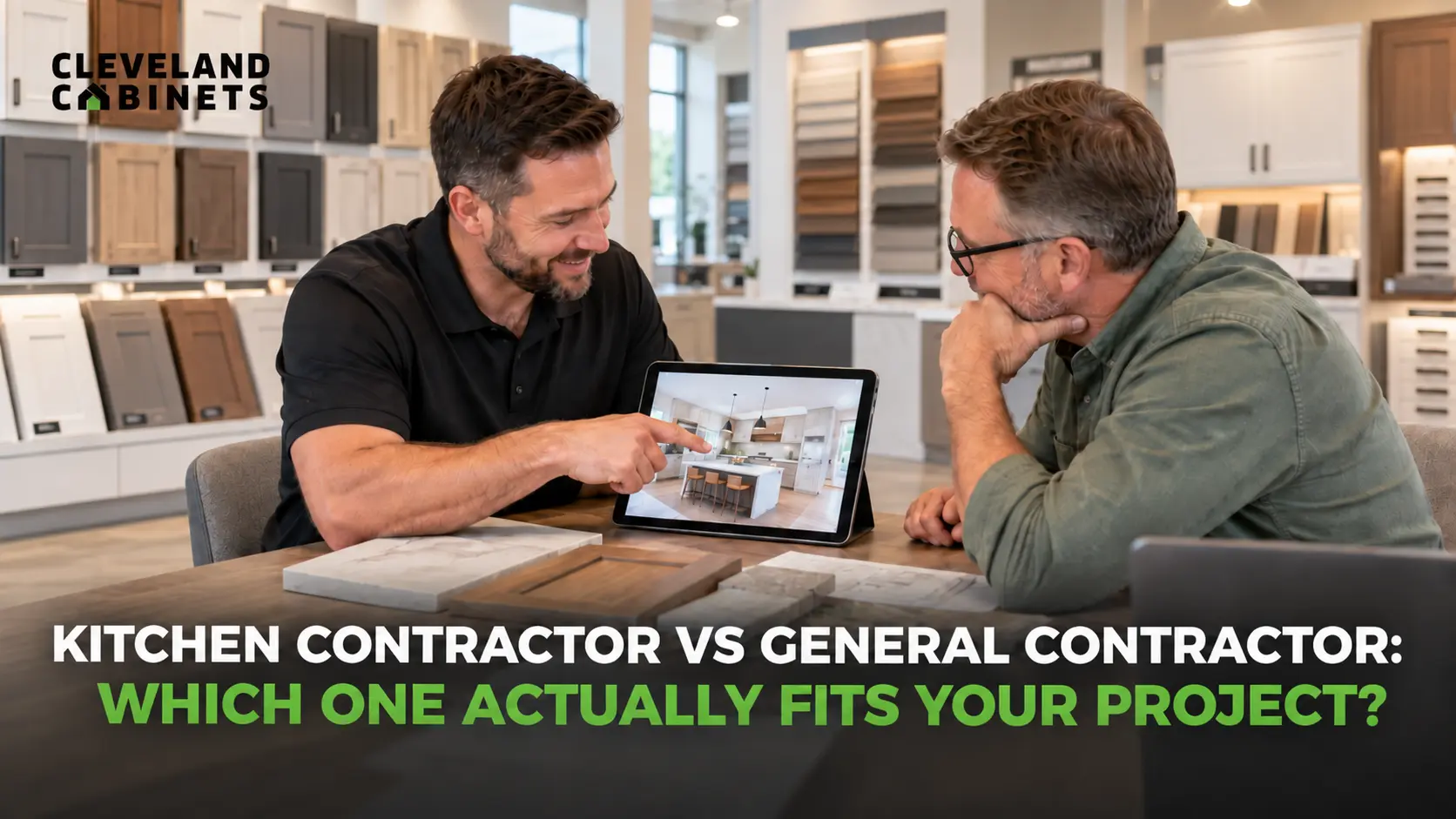
Not every professional who can remodel a kitchen is set up the same way. A general contractor and a kitchen contractor differ in licensing, in how they are paid, and in who actually designs the space. Knowing which one you are talking to before you sign anything can save you weeks of change orders and a kitchen that still does not work the way you pictured it. Here is how the two roles actually compare.
Homeowners usually meet this fork in the road the moment they start collecting quotes. One estimate comes from a company that also handles roofs, additions, and basements. Another comes from a team that designs and installs kitchens only. Both quotes might look similar on paper, but the process behind each one is not.
The confusion is not really about the words themselves. General contractor and kitchen contractor are job titles, not guarantees of scope or skill. What actually matters is who draws the layout, who orders the cabinets, and who stands behind the finished install if something needs fixing.
What a General Contractor Actually Does on a Kitchen Project
A general contractor manages the whole job. That means permits, subcontractors, and every trade from framing to finishing.
Their strength is coordination. If your kitchen remodel involves moving a load bearing wall, adding a bump out, or touching plumbing and electrical across multiple rooms, a general contractor is built for that scope.
Most general contractors are not dedicated kitchen designers. Some have a draftsman who can produce basic plans for a permit. For anything beyond that, they often bring in an outside designer or expect you to have one lined up already.
What a Kitchen Contractor Actually Does on a Kitchen Project
A kitchen contractor, sometimes called a kitchen remodeler or a design-build kitchen specialist, focuses on one room. That narrow focus changes how the whole project runs.
Design and Material Selection
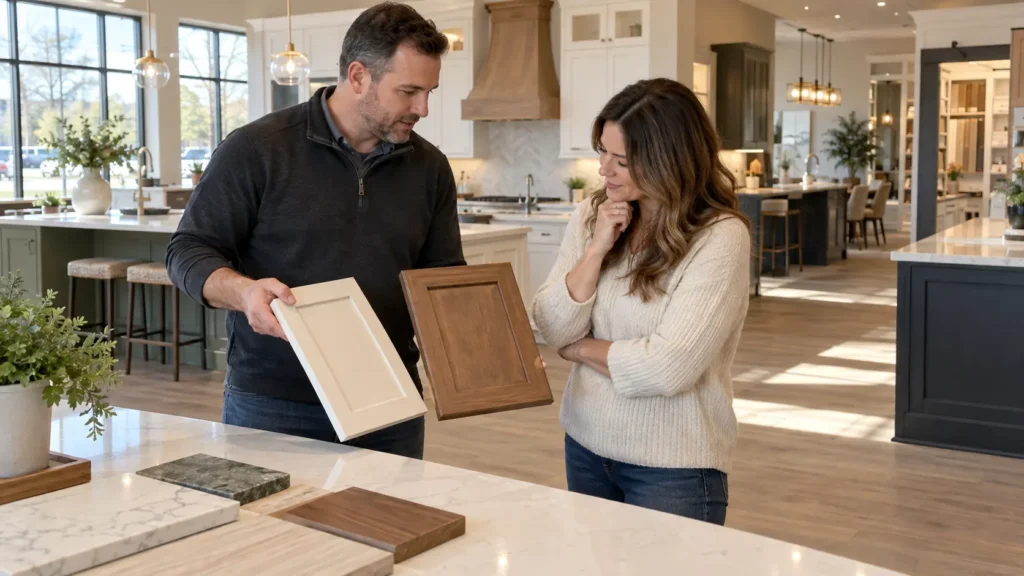
Design usually happens in house. You sit down with a designer, look at real cabinet doors and finishes, and walk through a layout built around how you actually cook.
Supply and Installation Under One Roof
Cabinets, countertops, and installation typically come from the same team. That means one point of accountability instead of a chain of separate vendors you have to coordinate yourself.
Where the Two Roles Overlap
Both a general contractor and a kitchen contractor can pull permits, hire subcontractors, and manage a construction timeline. Both are supposed to carry insurance and meet local licensing requirements.
The overlap is exactly why the labels confuse people. A title alone does not tell you who is actually running your kitchen project day to day.
Licensing and Insurance: What Northeast Ohio Homeowners Should Confirm
Licensing is one of the clearest ways to tell the two apart, but it is more layered in Ohio than most homeowners expect.
Ohio Has No Single Statewide License
Ohio does not issue one statewide general contractor license. Licensing for residential remodeling work is handled city by city, so a contractor licensed in one Cleveland suburb is not automatically licensed in the next one over.
What Ohio does require statewide, as of 2026, is registration through the Ohio Construction Industry Licensing Board for residential remodeling contracts. Contractors performing home construction services on contracts over $25,000 must also register as a Home Construction Service Supplier with the Ohio Attorney General’s office, and most full kitchen remodels cross that threshold.
Questions to Ask About Registration
Ask directly whether the contractor is registered with the city where your home sits, whether they carry general liability insurance, and whether their workers’ compensation coverage is current. A contractor who hesitates on any of these three answers is worth a second look.
Consumer Reports found that nearly one in five general contractors surveyed nationwide had no state license or insurance on file.
Cost Structure: How Each One Is Typically Paid
A general contractor commonly charges a percentage of the total project cost, since their fee covers coordinating every trade across a broader scope. A kitchen contractor’s fee is usually built into the supplied and installed cabinetry and countertop package, since the design, materials, and labor move through one company.
Neither structure is automatically cheaper. The right comparison is what is actually included in each number, not the number by itself.
Contractor fees on a typical kitchen remodel run 10 to 20 percent of the total project budget, based on industry data from Angi.
Project Management and Communication Differences
With a general contractor, you are often the person relaying decisions between the designer, the cabinet supplier, and the trades on site. That works fine if you enjoy managing the details.
With a kitchen contractor, one team usually carries the design, the material order, and the install schedule together. Fewer handoffs generally means fewer places for a decision to get lost.
Timeline Expectations for Each Path
A kitchen focused project with a design-build kitchen contractor commonly runs four to eight weeks from installation start to finish, once materials are in hand. A general contractor’s timeline depends heavily on how many other trades and rooms are involved, which can stretch a kitchen-only scope simply because it is one piece of a larger schedule.
Material lead time is usually the bigger factor than labor. Cabinets that are ordered rather than pulled from a generic stock line can take several weeks to arrive before installation even starts, so the eight week window many homeowners searching for kitchen contractors Fairview Park hear about often begins after the cabinets are already on site, not on the day the contract is signed.
Permitting adds another variable that differs by scope. A kitchen-only project usually clears permitting faster than a job that also touches an addition or a structural wall, since fewer inspections are required along the way. Asking either type of contractor for a written timeline broken into design, ordering, demolition, and installation phases makes it much easier to compare two very different quotes on equal footing.
Ask for a written timeline either way, tied to milestones rather than a single end date.
When a General Contractor Makes More Sense
If your project touches structural changes, an addition, or multiple rooms at once, a general contractor’s broader coordination is the better fit. They are set up to manage permits and trades across a scope that goes beyond one room.
When a Kitchen Contractor Makes More Sense
If the kitchen is the whole project and you want one team responsible for the design, the cabinets, and the install, a kitchen contractor is usually the more direct path.
Kamm’s Corners Homes and Older Kitchen Layouts
A lot of homes near Kamm’s Corners have original layouts from decades ago, tight galley kitchens or closed off floor plans that were common in that era of construction. A kitchen contractor who designs full time tends to have more reps solving that specific layout problem than a generalist juggling several trades at once.

Signs You Are Talking to the Wrong Fit
Watch for a contractor who cannot show you a real 3D rendering before demolition starts, who cannot name who specifically will be on site each day, or who gives a verbal estimate with no itemized breakdown. Those are signs the scope of what they actually do does not match what your project needs.
Another sign worth watching for is how a contractor handles a question they cannot answer on the spot. A pro who says “let me check and get back to you” is usually more trustworthy than one who invents a confident answer to avoid looking unprepared. Kitchens involve plumbing, electrical, and structural details that sometimes require a follow up, and a contractor comfortable saying so is not a red flag by itself.
Unplanned change orders during a remodel inflate the total project budget by an average of 10 percent, according to Consumer Reports.
Questions That Reveal Which One You Are Actually Hiring
Ask who draws the final layout, ask where the cabinets come from and who installs them, and ask for the license or registration number tied to your specific city. The answers usually make the label irrelevant. What matters is who is actually accountable for the finished kitchen.
A Fairview Park kitchen remodeling specialists team that handles design, supply, and installation together can often answer all three questions in one sitting, since there is no handoff between separate companies to track down.
If you are still working through the earlier planning stage, it also helps to read signs you need a kitchen designer before you start comparing bids, since that shapes which type of pro actually fits your project.
Cleveland Cabinets Serving the Kamm’s Corners Community and Beyond in Fairview Park
Homes near Kamm’s Corners sit close to Grannis Park, right around the intersection of Lorain Rd and Wooster Rd, at roughly 41.4515471, -81.8446792. That mix of established streets and older housing stock is exactly where the contractor-versus-specialist question comes up most often, since so many of these kitchens were never designed for how families cook today.
Get kitchen contractors Kamm’s Corners services now by working with a team that designs, supplies, and installs under one roof.
Navigate from Kamm’s Corners to Cleveland Cabinets Now
Frequently Asked Questions
What is the difference between a general contractor and a kitchen contractor?
A general contractor manages a broad scope across multiple trades and often multiple rooms. A kitchen contractor focuses only on the kitchen and usually handles design, cabinet supply, and installation as one connected process.
Do I need a licensed contractor for a kitchen remodel in Ohio?
Yes. Ohio requires city level licensing for residential remodeling work, and as of 2026 also requires statewide registration through the Ohio Construction Industry Licensing Board for most residential remodeling contracts.
Can a general contractor design my kitchen, or do I need a separate designer?
Some general contractors have a draftsman for basic permit plans, but most are not dedicated kitchen designers. Many homeowners bring in a separate designer or hire a kitchen contractor that includes design as part of the service.
How long does a typical kitchen remodel take from start to finish?
A kitchen focused remodel with a design-build kitchen contractor commonly runs four to eight weeks once materials arrive. A general contractor’s timeline varies more, since a kitchen is often one piece of a larger project schedule.
Is it more expensive to hire a specialist kitchen contractor than a general contractor?
Not automatically. General contractors typically charge a percentage tied to the full project scope, while kitchen contractors usually build their fee into the supplied and installed cabinetry package. Compare what is actually included, not just the number.